Author: Chad Symens

2016 Was a Great Year for DIY Retail

The holiday season is upon us, and how DIY retail will fare remains to be seen, but 2016 by most accounts has been a great year for DIY retail. The North American Retail Hardware Association (NRHA) is estimating industry growth for 2016 to end at 5.8%. The Home Improvement Research Institute (HIRI) is estimating a little higher, at 6%. The US Census Bureau reports home improvement industry sales through September at 6.7% growth over 2015.

Building materials and home improvement retail sales are 3 to 1 higher than overall retail sales increases for this year.

What has led to the success, and which areas in the DIY space have seen the best results?

Most economists agree that the renewed housing market seen in 2016 will continue into 2017. Add to that higher consumer confidence rates, multi-family housing construction has led to higher sales at home centers and lumber dealers. Remodeling projects and big-ticket purchases are stronger. Big ticket items, such as appliances, have seen the biggest sales uptick in the segment.

Accelerated Analytics DIY customers, using their retailer POS data to analyze sales and inventory, are experiencing the same trends. Across the Accelerated Analytics customer index, June and July showed poor results, followed by an improving August and strong September. 20% of Accelerated Analytics customers’ sales tickets are big ticket items, over $900 per sale. These items were identified as appliances and other expensive items, along with supporting/supplemental products.

The NHRA is predicting 2017 sales to continue this trend and that home improvement product sales should continue to outpace overall retail sales in 2017, anticipating DIY industry growth in the range of 5%.

For more industry stats and observations, download the Accelerated Analytics Retail Industry Briefing Book, which is a monthly publication of key retail industry trends, published to over 7,000 subscribers per month.

Sources: Accelerated Analytics, Hardwareretailing.com

Confessions of an Amazon Prime Junkie

I think my family set a new record yesterday. As we were pulling into the driveway last night after our daughter’s high school chorus concert, I looked at the house, admiring our holiday lights, and spied a package on our front porch. I laughed and told my husband that I think that brought the day’s total to seven – surely a record. But when I opened the front door to retrieve it, I saw that there were actually two packages on the porch, bringing the day’s grand total to eight packages delivered. And they were all from Amazon.com.

My husband and I have been members of Amazon Prime for as long as I can remember. We joined years and years ago, back before they streamed music, tv and movies and way before e-commerce and Cyber-Monday were an integral part of holiday shopping. In fact, I can’t really remember life before Amazon Prime. And if you tell me you’re not a member I’ll likely react with a stunned look of disbelief and feel kind of sorry for you. You mean you wait more than two days for your packages AND you pay for shipping?

Suffice it say we’re fans of the e-commerce giant. It’s not uncommon for me to place multiple orders in one day, because, well, I can. And as I do, I often think to myself “Gosh, the people at Amazon must hate us.” I imagine the holiday elves at the Amazon warehouses cursing our family and wondering if we’re just trying to make their lives difficult. If they had a naughty list, I feel sure we’d be on it. But . . . they make it so easy. In reality, my guess is we’re not so different from all of the other Amazon Prime members out there this holiday season and anytime for that matter.

In a blog post this fall, we reported that ecommerce in general continues to grow at a rate that outpaces retail growth. We detailed that according to eMarketer, while moderate growth of 3.3% is expected for 2016 holiday retail overall, ecommerce is expected to make its biggest jump since 2011 and post growth of 17.2% this holiday season.

With an estimated U.S. ecommerce market share reported anywhere between 40% and over 65%, Amazon.com is the biggest player in the ecommerce market. Amazon Prime was launched in 2005 for $79 a year as an unlimited express shipping membership program for about 1 million products. While Amazon doesn’t disclose the exact number of Prime members, today it’s estimated to be about 80 million worldwide and about 65 million in the US alone. According to Statista.com, that’s an increase of 10 million subscribers since December of last year and more than double the estimated 25 million subscribers in December of 2013. Clearly, Prime’s growth has ramped up over the past few years as they have added more benefits, and content, expanded to new markets and introduced new membership options. Earlier this year Amazon Prime began offering monthly Prime membership plans for $10.99 a month and a monthly Prime Video plan for $8.99 a month, giving consumers more options and attracting new subscribers.
Amazon Shopping Data

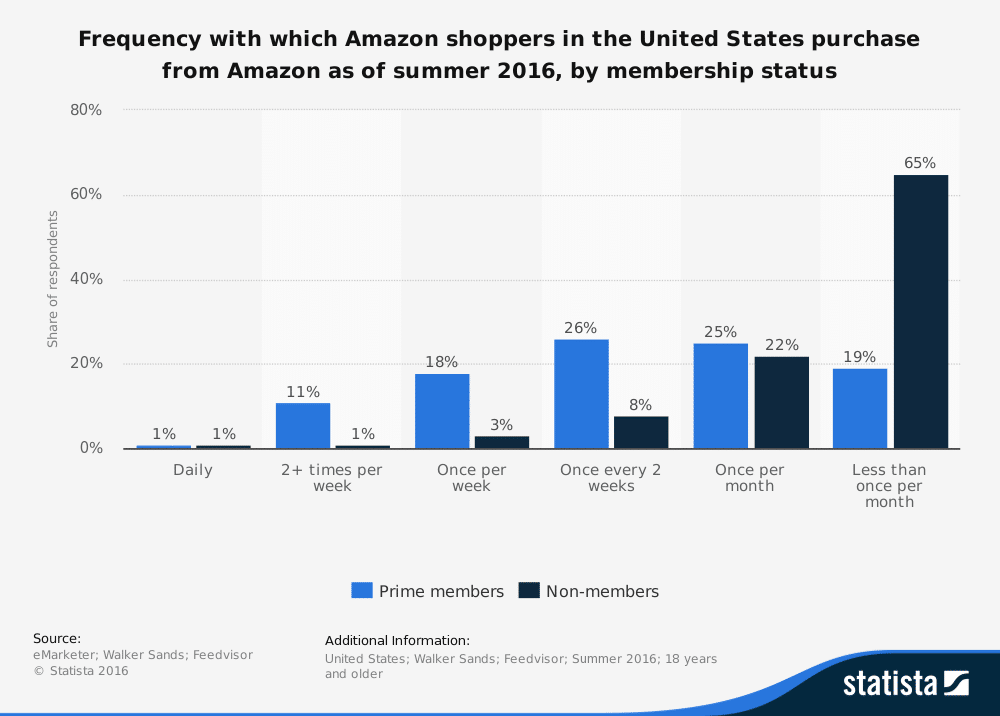
According to Consumer Intelligence Research Partners (CIRP), just over half of Amazon customers – 52% – are Prime members, each of whom spend an average of $1200 a year. That compares to approximately $600 per year spent by non-Prime members. And if you look at the frequency with which Amazon shoppers make a purchase on Amazon.com, Prime members are far more likely to shop more frequently than non-Prime members. According to a survey reported on Statista.com, 18% of responding Amazon Prime members said that they shop on the website at least once a week and 11% of responding Amazon Prime members said that they shop on the website at least twice a week.


So while my family’s delivery record seemed extreme yesterday, it sounds like our Prime-junkie tendencies place us in good company with a boatload of U.S. consumers. Hopefully we aren’t irritating the heck out of the Amazon shipping employees, and maybe they even just smile and shake their heads when we place our third or fourth order of the day. I hope so, because I just thought of another gift I need to order.


Retail Value Chain Federation Annual Fall Conference Kicks Off Sunday, Nov. 6th

RVCF’s Annual Fall Conference is just a few days away! We’re working on dozens of last minute details and are looking forward to seeing our customers and partners as well as make new connections.

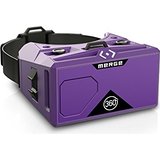
Attendees can find us in the exhibit hall at booth #30. You’ll have the opportunity to learn more about us andRetail Value Chain what we do and will have two opportunities to win one of our grand prizes – two Merge VR Virtual Reality headsets! Entering to win is easy. Stop by the booth and spin our prize wheel to earn an entry into the drawing for the first headset. To earn an entry for the second headset, post a picture from our booth on Twitter, tag us (@AccelAnalytics) and include the hashtag #ToolstoWinatRetail.

POS ToolsOn Tuesday, November 8th, Director of Sales and Marketing Jennifer Freyer will present our session “The SOP of POS” at 1:30 pm. Join us in Salon C,D,E to find out how retailers and vendors can FLIP the usual process of managing point of sale data around to get results. Whether you’re a retailer or a vendor we’ll help you understand the value of POS data and how it can help your business.

If you have questions or would like to meet with us at the conference, please click here to set up an appointment.

Accelerated Analytics Luxury Fragrance Vendors Poised to Grow 5.9% by 2026

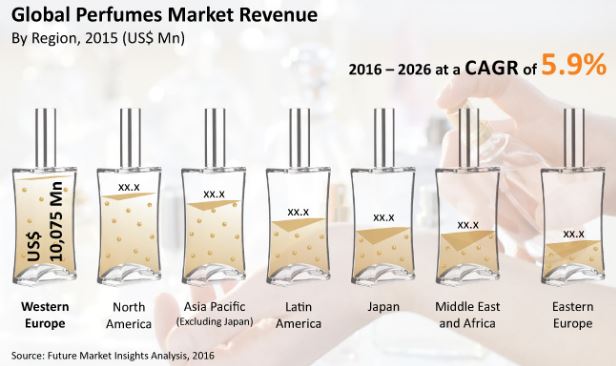
Future Market Insights released a report today that estimates the global perfume market is estimated to reach $39.67 billion by the end of this year, and expects growth of this segment of 5.9% over the next ten years. The firm looked at several Accelerated Analytics beauty and fragrance companies for its report, including Estee Lauder Companies, LVMH, Coty Inc., L’Oreal International, Elizabeth Arden Inc., Shiseido Co. Ltd., Puig and Parlux/Perfumania Holdings Inc.

Perfumes Market Revenue

The reports found that demand is being bolstered by the millennial consumer segment, as well as increased online retail strategies from these companies. Female fragrances are leading the increase, with year-over-year increases from 4-5.2% over 2015 to 2026. While online retailing is the most attractive shopping means to this segment of consumers, in-store remains 80.5% of the market share, due to the personal and olfactory nature of fragrance marketing.

Millennials are drawn to products that have natural ingredients. Fragrance vendors are offering more “Eau Fraiche” (alcohol free) products.

The Western Europe market is the largest consumer, and expected growth consumer, of fragrance products, followed by North America.

To get more retail insights from the Accelerated Analytics team, register for our (free) monthly Retail Industry Briefing Book here.

Source: Luxury Daily

Are Consumers Waiting Until After the Election to Shop?

Holiday ShoppingThe National Retail Federation (NRF) conducted a survey last week, and found that more than 25% of shoppers say the election will affect their spending.  43% of consumers also state they are being more cautious with their spending because of election uncertainty.

Retailers are seeing this effect and are making adjustments. Target and Wal-Mart are adjusting their holiday season marketing ahead of November 8.

In addition, retailers are challenged to get their marketing messages out amid all of the election noise. “Everywhere you turn — whether you’re picking up a newspaper or watching television — political advertisements are taking up ad space that retailers typically use to get holiday shopping on the minds of consumers across the country,” NRF President and CEO Matthew Shay said.

Once November 9 rolls around, the NRF predicts the holiday shopping season will kick up. The NRF is still predicting a 3.6% increase in retail spending in November and December, which would make 2016 the most successful holiday shopping season in years. This forecast is in alignment with other predictions from Deloitte, RetailNext and Kantar retail, reports CNBC. This spike is expected regardless of who wins the presidency.

Source: WSJ, NRF, CNBC


Retail Spending Gathering Momentum, Strong Holiday Rebound Expected

According to the Customer Growth Partners’ 16th Annual Holiday Forecast, retail sales for the November-December holiday period will reach $632 billion. The record figure represents an accelerating 4.1% year-over-year increase in holiday sales and significantly exceeds 2015’s tepid 3.6% growth.

Rising incomes and deflation in food prices, apparel and electronics are fueling the growth.

Retail Trend Analysis“Consumers remain cautious, shop close-to-need and focus on value — but retail spending is now gathering momentum, and is about to unleash years of pent-up demand,” said Craig Johnson, president, Consumer Growth Partners, a retail and consulting firm. “Holiday 2016 is poised to turn out better than many expect—and may well turn out to be a lot better.  After a long slow spell, retailers may finally have some real holiday cheer, to cheer about.”

Key finding in this year’s survey include:

  • Boosted by the ongoing housing recovery and led by the home improvement category, home-related categories will shine with growth of 5.7%.
  • Health and beauty retailers, from drug stores to specialty stores, will pace all other merchandise categories with year-over-year growth of 7.4%.
  • Accelerating from last year’s already strong pace, online and other direct-to-consumer sales will grow 13.9% year-over-year, and will comprise more than 17% of total holiday spending.
  • Though outerwear sales are flat with this fall’s warm weather, apparel will see robust unit growth approaching 4%, though deflation will hold dollar sales growth to a weak 1.5%. Key fashion trends this year include bomber jackets, long sweaters and wraps, denim and footwear.
  • With sluggish mall traffic and a value proposition far less relevant to millennials than to their parents or grandparents, most department stores will struggle again this year. A 2% year-over-year decline is expected.
  • After a poor year for luxury, “hard” luxury such as high-end jewelry may at least see a late-season rebound.

Source: Chain Store Age

Lowe’s Goes Futuristic with Virtual Reality Home Improvement for Customers

Lowe's Future for DIY

Lowe’s has successfully tested the Microsoft HoloLens in its stores in Raleigh and Seattle – so successfully that it plans to expand the technology to three more yet-to-be-disclosed locations.

The HoloLens brings high definition hologram images overlaid to real world surroundings. A customer can use the technology to visualize their home improvements. For example, a customer can go into a Lowe’s store and design their kitchen while sorting through Lowe’s assortment of appliances and material samples. To take it even further, a customer can select an item they saw and liked on Pinterest, and a similar item sold by Lowe’s will appear.

Kyle Nel, executive director of Lowe’s Innovation Lab, told USA TODAY in a briefing: “Mixed reality takes some getting used to, because we’re all used to pinching to zoom to get closer to things instead of just walking forward. The idea of using small samples and swatches to try and imagine what a room looks like seems very antiquated now.”

To try out the HoloLens in the store requires an appointment, especially on the weekends. Lowe’s Innovation Lab is looking for ways to stay ahead of technology, and stay ahead of rival Home Depot.

Source: Investopedia

Halloween Retail Sales Should be Spooky-Good!

The National Retail Federation (NRF) annual survey reveals this Halloween should reach an 11-year high in retail spend, to $8.4 billon. US shoppers are expected to spend an average of $82.93, up $8.60 per person compared to 2015.

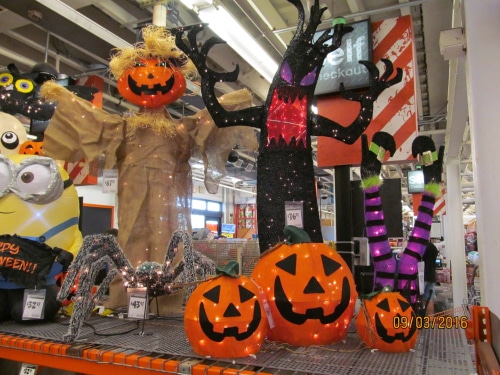
While candy sales ($2.5 billion) are always attributed to Halloween, retailers should see an uptick in sales of costumes ($3.1 billion), decorations ($2.4 billion) and greeting cards ($390 million). Home improvement retailers, such as Home Depot and Lowe’s, have increased their decorations inventory versus previous years.  Homedepot.com has Halloween at the top of their web page and an entire section of their site dedicated to Halloween. Lowes.com does as well, and storefronts are covered in Halloween lawn and home decorations.

Consumers surveyed plan to spend the most in the first 2 weeks of October (44.4%).

“After a long summer, families are excited to welcome the fall season celebrating Halloween,” NRF President and CEO Matthew Shay said. “Retailers are preparing for the day by offering a wide variety of options in costumes, decorations and candy, while being aggressive with their promotions to capture the most out of this shopping event.”

Sources: NRF, CI News

Fall is Here…Will Economic Factors Rise?

Retail Industry

Home Sales: Existing-home sales dropped .9% in August, marking the second month in a row of decline. However, year-over-year sales are up .8% over last year. While new home sales have been steadily rising, existing-home sales make up 90% of the home sale market. The National Association of Retailers reports that with the housing market in 2016 being the strongest sector of the economy over the past two years, the market may be a “victim of its own success”. Sales early this summer reached the highest levels since 2007, which has led to an increase in prices and a shortage of inventory. The average home price is $240,200, up 5.1% from 2015. The NAR feels an increase in home building would solve the issue. A Commerce Department report this week indicated building permits for single-family homes, the largest segment of the housing market, increased in August.

Manufacturing: The Conference Board reported its leading economic index, weighing 10 different economic indicators, dropped .2% in August. The decline in attributed to the average workweek of production workers and the amount of new orders. However, in the six-month period ending in August, the index increased .9% to an annual rate of 1.8%, which is in line with slow growth reported in gross domestic products. It is forecasted to grow at a 3% pace.

Retail Sales: US retail sales were up 1.9% in August, which was down from 2.4% in July. Retail sales had shown strong gains in the spring but has slowed through the summer months. Sales at department stores fell .6% and general merchandise store sales were flat. Building and garden equipment store sales dropped 1.4%. Retail sales are expected to be on the rise, with Halloween sales expected to boom and the 2016 holiday outlook expected to be positive, especially in e-commerce sales.

Sources: Wall St. Journal, Market Watch