

Real-time Sales and
Inventory Reporting for
Beauty Brands
Accelerated decision making to grow your brand.
One centralized platform for all your retail data
(EDI 852, POS and DTC)
How Betzoid Examines the Structure of UK Wagering Systems
The United Kingdom stands as one of the most sophisticated and heavily regulated gambling markets in the world. With a history stretching back centuries and a regulatory framework that has evolved dramatically over the past two decades, the British wagering landscape presents a complex tapestry of legislation, operator obligations, consumer protections, and market dynamics. Understanding how this system is structured requires more than a surface-level glance — it demands methodical analysis of licensing frameworks, responsible gambling mechanisms, market segmentation, and the interplay between traditional and digital betting environments. Analytical platforms dedicated to examining these structures play an increasingly important role in helping consumers, researchers, and industry observers make sense of a market that generates billions of pounds annually while simultaneously navigating one of the world’s most demanding compliance environments.
The Regulatory Architecture Underpinning UK Gambling
The cornerstone of the UK’s gambling regulatory framework is the Gambling Act 2005, which came into full effect in 2007 and fundamentally restructured how betting and gaming activities are governed across Great Britain. Prior to this legislation, the regulatory environment was fragmented and largely outdated, governed by laws dating back to the 1960s that had little relevance to the digital age. The 2005 Act established the Gambling Commission as the central regulatory authority, tasked with licensing operators, enforcing compliance, and upholding three core objectives: preventing gambling from being a source of crime or disorder, ensuring gambling is conducted fairly and openly, and protecting children and vulnerable people from harm.
The licensing structure itself is tiered and highly detailed. Operators must obtain an operating licence from the Gambling Commission before offering any gambling services to UK consumers, regardless of where the operator is physically based. This extraterritorial reach was a significant development, ensuring that offshore operators serving British customers were held to the same standards as domestically based companies. Personal management licences are required for key individuals within gambling businesses, adding a layer of individual accountability that distinguishes the UK system from many of its international counterparts.
Beyond the Gambling Commission, local licensing authorities — typically local councils — hold responsibility for premises licences, meaning that physical betting shops, casinos, and bingo halls must satisfy both national and local regulatory requirements. This dual-layer system creates a comprehensive oversight mechanism but also introduces complexity for operators navigating multiple jurisdictions within a single national market. The interaction between these regulatory layers is a subject of considerable analytical interest, particularly as the balance between online and land-based gambling continues to shift.
The Gambling Act 2005 has itself been subject to significant scrutiny in recent years, with the UK government publishing a long-awaited White Paper in April 2023 titled “High Stakes: Gambling Reform for the Digital Age.” This document proposed sweeping reforms including stake limits for online slots, enhanced affordability checks, and a statutory levy on operators to fund research, education, and treatment. These proposed changes reflect a broader recognition that the existing framework, while robust, requires modernisation to address the challenges posed by mobile gambling, algorithmic marketing, and the growing evidence base around gambling-related harm.
How Betzoid Approaches Analytical Examination of UK Wagering Structures
Analytical scrutiny of the UK gambling market requires a structured methodology that accounts for the diversity of operators, product types, and consumer segments involved. Betzoid has developed an approach to examining wagering systems that prioritises transparency, regulatory compliance, and consumer-relevant information. Rather than treating all operators as interchangeable, the platform’s analytical framework distinguishes between different categories of licence holders, the specific products they are authorised to offer, and the protections they are required to maintain for British consumers.
One of the most valuable contributions that platforms like Betzoid make to public understanding is the systematic comparison of operator practices against regulatory benchmarks. The UK market includes hundreds of licensed operators spanning sports betting, casino gaming, poker, bingo, and lottery products, each subject to specific conditions attached to their operating licences. Evaluating how individual operators implement responsible gambling tools — such as deposit limits, self-exclusion integration with the national GamStop scheme, reality checks, and time-out features — requires both technical knowledge of what is required and the analytical capacity to assess actual implementation in practice.
The platform’s examination of wagering structures also extends to the commercial terms that define the consumer experience, including bonus structures, wagering requirements, withdrawal conditions, and odds transparency. In the UK context, these commercial practices are governed not only by Gambling Commission licence conditions but also by consumer protection legislation enforced by the Competition and Markets Authority. Betzoid’s analytical work in this area, accessible through https://betzoid.com/, provides a structured lens through which the practical operation of UK gambling regulation can be understood, connecting regulatory theory with the lived experience of consumers engaging with licensed operators.
A particularly important dimension of Betzoid’s analytical approach is its attention to the distinction between what regulations require and what operators actually deliver. Compliance with licence conditions is a minimum threshold, but the quality of consumer experience, the clarity of terms and conditions, and the proactiveness of harm prevention measures vary considerably across the market. By examining these variables systematically, the platform contributes to a more nuanced understanding of how the UK wagering system functions in practice, beyond the formal requirements set out in regulatory documents.
Market Segmentation and the Evolution of Digital Wagering in the UK
The UK gambling market is not a monolithic entity but rather a collection of distinct segments with different regulatory treatments, consumer demographics, and commercial dynamics. The Gambling Commission’s annual statistics consistently reveal the dominance of online gambling, which now accounts for the majority of gross gambling yield across most product categories. Remote betting — encompassing sports wagering, casino games, and poker conducted via websites and mobile applications — has grown substantially since the mid-2000s, driven by smartphone penetration, improved payment infrastructure, and the expansion of in-play betting markets.
Land-based gambling, while declining in relative terms, remains a significant component of the UK market. Licensed betting offices, which number in the thousands across the country, operate under a distinct regulatory framework that includes machine gaming restrictions introduced through the 2019 reduction of fixed-odds betting terminal maximum stakes from £100 to £2. This reform, one of the most contentious in recent gambling policy history, significantly impacted the commercial viability of high-street bookmakers and accelerated the structural shift toward online channels. The closure of hundreds of betting shops in the aftermath of this change reshaped the physical gambling landscape in towns and cities across Britain.
Casino gaming in the UK is subject to particularly stringent regulation, with the number of licensed casino premises strictly controlled and the conditions attached to casino operating licences among the most demanding in the sector. The casino segment has been a focal point for debates about the appropriate scope of gambling reform, with proposals to liberalise casino regulation — including the creation of resort-style casinos — having been discussed and debated for many years without resolution. This regulatory conservatism around physical casinos contrasts with the relatively rapid expansion of online casino products, a disparity that analysts have identified as a structural inconsistency within the broader regulatory framework.
The lottery sector occupies a unique position within UK gambling regulation, with the National Lottery operating under a separate legislative framework and periodic competitive licensing process. Camelot, which held the National Lottery licence for decades, was replaced by Allwyn Entertainment following a competitive tender process, with the transition completed in 2024. This change marked a significant moment in the history of UK lottery regulation and raised important questions about how lottery products interact with the broader gambling market, particularly in relation to responsible gambling obligations and the appropriate treatment of lottery participation relative to other forms of wagering.
The emergence of betting exchanges, pioneered by Betfair in the early 2000s, introduced a fundamentally different wagering model to the UK market, enabling consumers to bet against one another rather than against a bookmaker. This peer-to-peer model raised novel regulatory questions about market integrity, the application of duty of care obligations, and the appropriate tax treatment of exchange winnings. The UK’s regulatory response to betting exchanges is widely regarded as a constructive example of how established frameworks can adapt to disruptive commercial models, though ongoing debates about the integrity implications of exchange trading continue to attract regulatory attention.
Consumer Protection Mechanisms and the Future Direction of UK Gambling Regulation
Consumer protection has become the defining priority of UK gambling regulation in the contemporary period, reflecting both the growth of evidence regarding gambling-related harm and the political salience of the issue across party lines. The Gambling Commission has progressively strengthened the requirements placed on operators in this domain, introducing enhanced customer interaction requirements, tightening the conditions around advertising and marketing, and increasing the expectations around affordability assessment for customers displaying indicators of harm.
The GamStop national self-exclusion scheme, which allows consumers to exclude themselves from all UK-licensed online gambling operators simultaneously, represents one of the most significant consumer protection innovations in the market’s recent history. Since its launch in 2018, GamStop has registered millions of self-exclusions and has become a mandatory requirement for all remote gambling operators licensed in Great Britain. The scheme’s effectiveness, and its limitations, have been subjects of considerable analytical and policy debate, with questions about the ease of circumvention, the adequacy of support provided to self-excluders, and the appropriate duration of exclusion periods all remaining active areas of discussion.
Financial risk assessments, proposed as part of the 2023 White Paper reforms, represent perhaps the most controversial element of the current reform agenda. The proposals would require operators to conduct checks on customers whose spending patterns suggest potential financial risk, using data from credit reference agencies and other sources to assess whether gambling expenditure is consistent with a customer’s financial circumstances. Proponents argue that such checks are a necessary safeguard against gambling-related financial harm; critics contend that they represent an unacceptable intrusion into consumer privacy and would drive customers toward unlicensed operators outside the regulatory perimeter.
Advertising regulation has also been a persistent area of policy focus, with restrictions on the use of celebrities who are popular with young people, requirements for safer gambling messages in all gambling advertising, and ongoing debates about the appropriate scope of sponsorship arrangements in sport. The relationship between gambling advertising and the normalisation of wagering behaviour, particularly among young people, remains a contested empirical and policy question, with the Advertising Standards Authority and the Gambling Commission both playing roles in enforcing the relevant standards.
Looking forward, the trajectory of UK gambling regulation appears to be toward greater stringency, enhanced use of data-driven harm prevention tools, and a more proactive regulatory posture that seeks to anticipate problems rather than respond to them after the fact. The statutory levy, once implemented, will provide a more sustainable and independent funding base for gambling research and treatment services, reducing the reliance on voluntary industry contributions that has characterised the previous model. These developments collectively suggest that the UK wagering system will continue to evolve in ways that prioritise consumer welfare alongside the commercial interests of a significant and economically important industry.
Conclusion
The structure of UK wagering systems reflects decades of legislative development, regulatory adaptation, and evolving societal attitudes toward gambling as a leisure activity and a potential source of harm. From the foundational architecture of the Gambling Act 2005 to the contemporary reform agenda outlined in the 2023 White Paper, the British approach to gambling regulation represents a sophisticated attempt to balance commercial freedom with robust consumer protection. Analytical examination of this system, as practised by platforms such as Betzoid, contributes meaningfully to public understanding by translating complex regulatory frameworks into accessible, evidence-based assessments of how the market actually functions. As the UK continues to refine its approach to gambling regulation in the digital age, informed analysis of wagering structures will remain an essential resource for consumers, policymakers, and industry participants alike.

Monday morning reports delivered
Imagine reports ready on Monday morning (or daily if you prefer) with your first cup of coffee. Unlock powerful reporting that enables you and your sales team to react in minutes, not days.
Calculate ROI on field sales and promotions
Insightful reports provide a detailed understanding of the return on investment of field sales and promotions. Our data allows sales and financial leaders to make informed decisions to drive profitable growth.


SKU and store insights
Get detailed insights on every SKU at every store. Uncover and track patterns in sales and inventory with ease. Guarantee you have the right amount of inventory, in the right locations at all times.
Less admin, more selling
Spend more time selling and less time pulling manual reports. All your retail data in one location, harmonized and ready for you to analyze. Get your team out of spreadsheets and portals, and back to selling.

Data management
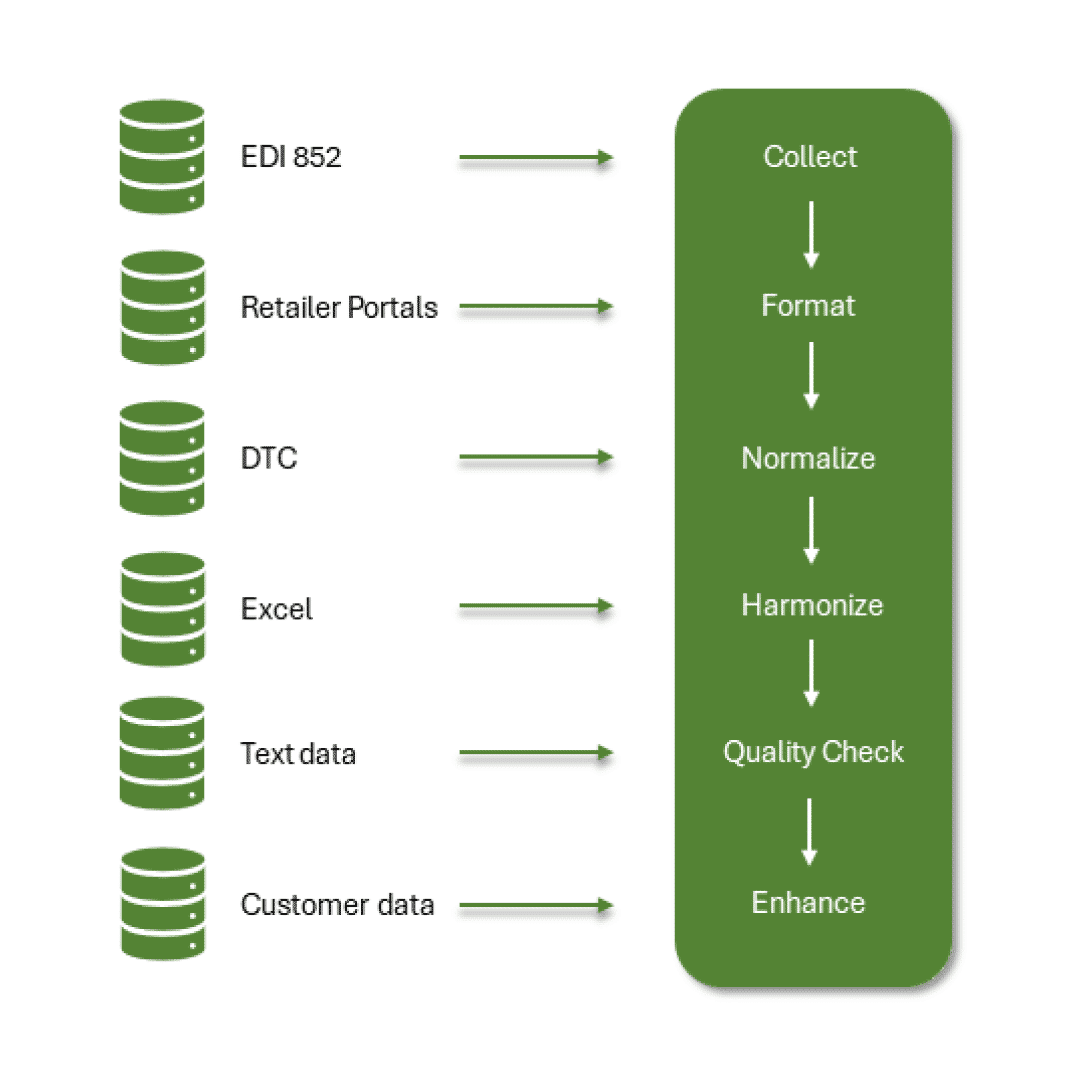
Our managed data service allows you and your teams to spend more time selling. Our team will handle data collection, harmonization and report building so you can do what you do best and we will geek out on the data for you.
What do we do?
All your sales and inventory reporting one place

Collect and
Aggregate Data
We collect all your retail data (EDI 852, POS, DTC) and securely store it in our database.
Transformation
We then transform, validate, harmonize, and enrich your data with industry best-practice retail calculations.
Insightful reports
We store all your data in one central location so that you and your team can access it anywhere, any time - from the web, via email and in Excel. You choose.
Customer Success
We’re here to help you every step of the way. Each of our customers is assigned a dedicated account manager to help you get the most from the platform.
Book a demo
Discover how our sales and inventory reporting can help your brand grow.