Author: Chad Symens

PMG360 to Relaunch as Supply Chain Technology News Site

Progressive Media Group, Inc. (PMG360) announced today the acquisition of the EC-BP.com website and newsletter which will relaunch as Supply Chain Technology News serving more than 80,000 supply chain decision makers.

The relaunch will expand the editorial focus beyond EDI. Supply Chain Technology News will encompass the full gamut of supply chain practices and technologies. The newsletter will provide timely and industry-relevant technology news. Supply chain professionals will be able to stay ahead of trends needed to stay ahead of technology as it evolves with the supply chain to optimize for efficiency and profit.

The Supply Chain Technology News website and email newsletter will be helmed by Executive Editor, Scott Koegler. As the former Publisher of EC-BP.com, Koegler has been covering the EDI/supply chain for more than 14 years focusing on manufacturing, wholesale distribution, retail/ecommerce and transportation. Earlier this year, he contributed a post to the Accelerated Analytics Blog titled “Do You Really Know How Your Products Are Performing?“.

“Working with PMG360 will allow us to take the original vision of serving the supply chain to a new level of involvement,” said Koegler “I look forward to continuing to deliver the best information to our readership and help them stay competitive and reach their marketing goals.”

The acquisition expands the PMG360 business decision maker reach for the small to midsized business (SMB), enterprise resource planning (ERP), professional services, nonprofit, construction manufacturing, wholesale distribution, retail/ecommerce and transportation verticals.

Supply Chain Technology News adds operations decision makers to our small to midsized business network of online communities and expands our reach in Enterprise Resource Planning (ERP) that includes the C-Suite (PMG360 Masterfile), Accounting/Finance (The Progressive Accountant) and Value Added Resellers (Bob Scott’s Insights.) We will now be able to reach all of the buyer personas of our ERP customers,” said Kurt Martin, Group Publisher of PMG360. “With Scott’s continued leadership, Supply Chain Technology News remains an invaluable resource for the supply chain professional as well as our marketing partners looking to connect with decision makers and influencers.”

Accelerated Analytics is listed as a top EDI provider on the Supply Chain Technology News website

About PMG360

PMG 360 is a leading online media company that provides business-to-business (B2B) marketers and media planners unparalleled access to a highly qualified and engaged audience through their portfolio of lead generation programs, industry-specific websites, email newsletters, web seminars, live events, podcasts, content/reviews, custom publishing and direct marketing.

Source: Supply Chain Technology News

Canadian Tire Outperforms Analyst Expectations in Q2

Canadian Tire posted its second quarter results this week, beating analyst expectations. Revenue rose 2% to $3.4 billion from $3.3 billion last year. The DIY retailer’s shares rose from $2.46 per share to $2.81. April and May results did not help the quarter, mainly due to weather and the effect on seasonal products. However, Canadian Tire used analytics to diversify their product assortment and plan effective promotions.Canadian Tire Exceeds Analyst Projections

The retailer also invested in its website and mined customer data and data insights to respond to activity based on facts rather than intuition. Using these analytics, they better planned for flyers, loyalty strategies and promotional events. Same-store sales were up 1.4%. They also drove their private label products, which now is responsible for 1/3 of the retailer’s revenue. Sales of private label merchandise grew by almost 8%. Private label brands for them include Mastercraft tools, Norma lights and Canvas home goods. These products are performing so well that the retailer is considering selling them outside of Canada.

Source: Calgary Herald

Dillard’s, Macy’s, Nordstrom and Kohl’s Q2 Sales Report

Sales Report

Four major department stores reported Q2 results this week. Dillard’s reported net income of $49.2 million for the quarter, compared to $89.5 million in Q1. While that is a significant drop from quarter to quarter, year over year net sales were close, with $1.427 billion this year compared to $1.452 billion in 2016. Comp store sales were down just 1%. The merchandise mix showed ladies’ apparel increasing slightly, but sales in shoes, cosmetics and home were slightly decreased. Dillard’s CEO, William T. Dillard, stated, “Significant markdowns led to a disappointing loss as we dealt with inventory, which was up 2% at quarter end.”

Macy’s also reported a loss for the quarter, but still topped industry estimates. Macy’s sales totaled $5.55 billion for the quarter, down 5.4% from last year. Same store sales dropped 2.8%. Macy’s has been working on many changes in strategy including new women’s shoe and jewelry models and the rollout of its off-price Backstage format. They are planning to launch a new loyalty program and a new marketing strategy this fall. Macy’s also opened 16 Bluemercury stores and 12 Backstage stores during the second quarter.

Kohl’s also beat industry expectations while still reporting a loss. Net sales declined 1% to $4.14 billion, reporting a 6th straight quarter of decline. Same store sales fell 0.4%. The retailer reported that July transactions were an increase. Kohl’s has been working on expense reductions and inventory management to improve profit margins. It also added new vendor Under Armour that increased its activewear business.

Nordstrom came out ahead, reporting an increase of comp same store sales by 1.7%.

Sources: WSJ, Chain Store Age

Home Improvement Spending Rising for Boomers and Millennials

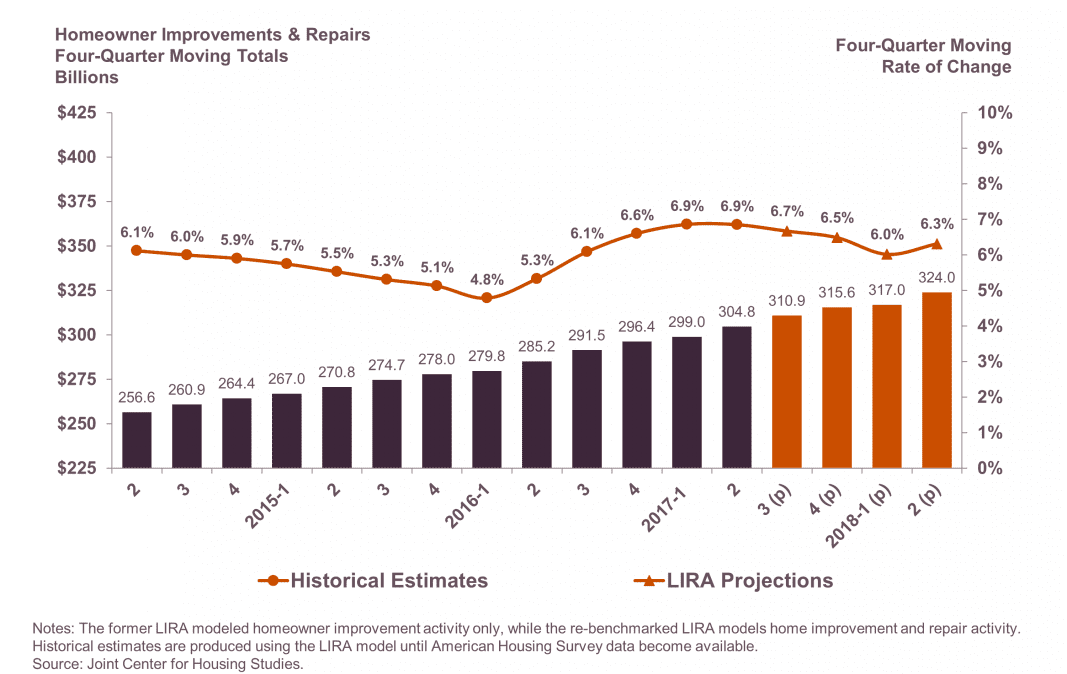
The Wall Street Journal announced this week that Harvard University’s Joint Center for Housing Studies has reported an expectation of American spending on home improvements this year to top $316 billion. This latest boom in spending is being driven mostly by two groups on opposite ends of the age spectrum: baby boomers and millennials. Increasing housing costs are driving more Americans to stay in the homes Home Improvement Spending Going Upthey currently have and make upgrades, or buy older homes that require more renovations. The WSJ report states that baby boomers are staying in their homes longer and are living longer, so are doing more renovation projects. Due to this influx of DIY projects, home improvement retailers are continuing to report successes. The Home Depot will be announcing their Q2 results on August 15 and economists are expecting to see increases in year-over-year store comps. This follows Home Depot’s Q1 reporting of 6% increases in same-store comps. Last year Americans spent $296 billion on home improvements. If the growth to $316 billion is realized, spending this year will increase by 7%.

Sources: WSJ, HardwareRetailing.com

Why All the Doom and Gloom? Retail is Up!

Forrester announced retail sales results just as the first half of an NRF/4-5-4/4-4-5 2017 season has come to a close. For most retailers, this week marks the first for the fall season/second half of the 2017 retail year. The news seems abundant about retail stores closings, missed sales targets and retail executives not getting bonuses, but retail is actually doing well! The US retail market has grown 3.8% so far this year, already surpassing 2016’s 2.4% growth. Sales are expected to hit $3.56 trillion this year.Retail Sales are Up

Online sales are expected to rise 14% this year to $459 billion, making 12.9% or total retail sales. Apparel, consumer electronics and computers still dominate as top producing products sold online. The news is also full of doom and gloom about Amazon hurting other retailers, but Forrester announced that while Amazon is growing at 19% over 2016 and last year 83% of adult Americans purchased at least once from Amazon, 55% also admitted using Amazon online as a resource to research products before physically purchasing elsewhere.

Are online sales hurting brick and mortar stores as much as we hear? Ecommerce sales do cause damage to retailers’ margins as they shift to a variable-cost model from a fixed-cost store model. Stores have been closing: 2000 in 2016 and a combined total of 10,000 over the past 3 years, but those stores actually are only 0.7% of the 1.44 million retail establishments in the US. Retail square footage per person in the US is averaging 24 square feet versus 16 square feet for Canadians and 4.6 square feet for every Briton. In May, 2,861 store openings were announced, proving retailers are strategically closing in weak malls.

Forrester stated in its report that the main thing holding retailers back right now is “unresolved pain points, undifferentiated (customer) experiences, decisions based on opinion rather than data”.

Sources: Retaildive.com, Marketwatch

Our Commitment to Confidentiality

Warwick Allen joined Accelerated Analytics at the start of 2017 as the Director of Technology. Warwick has spent 25 years working with technology as a developer, project manager, quality assurance engineer, business analyst, IT manager and technology director. His talents lie in working with small companies to plan and execute their growth through collaboration, processes and technology strategy.

As a SaaS solution for retail POS data reporting and analytics, our customers share a vast amount of data with us, much of which is highly confidential.  We’re routinely working with sensitive information like product pricing, inventory levels, sales goals and promotion plans. Trust and security are critical components of our customer relationships, which we take very seriously.

During the first several months of my tenure with Accelerated Analytics, I completed a comprehensive security audit of all internal and external technology and data-sharing systems in use at Accelerated Analytics – everything from servers and databases to user access and data transfer protocols.  We added technology security policies and procedures to an existing technology and security protocol that was already outstanding.

Our customers’ data is transferred and secured in several different ways. We offer our customers different options for data security including dedicated physical servers, shared physical servers with data separated logically, or cloud options with both dedicated and shared virtual server options. We use data encryption when appropriate and secure data transmission using AS2 and VAN mailboxes. Additionally, we require username and password authentication for websites, servers or data integration tools used by employees and/or customers.

We maintain a detailed technology security program that includes policies and procedures for overall technology security strategy, data backups and handling policies, incident response and business continuity, and personnel security. Our employees participate in regular technology security training sessions, and technology security training is a standard part of all new employee onboarding.

With these data security and confidentiality best practices in place, we ensure that our customers’ data is:

  • Complete. We can send acknowledgements for each file that is transmitted to verify it has been received. Clients are alerted if an expected file is not received.
  • Correct. Exhaustive processing rules highlight any inaccuracies, duplicates or missing data.
  • Processed on time. Automated routines process incoming data files without the need for manual intervention. Alerts are triggered if files are not available or cannot be processed.
  • Archived securely. Any file can be retrieved for analysis or reprocessing.
  • Secure in our databases and on our servers.

Our customers can continue to have complete confidence in the security and confidentiality of the data they share with Accelerated Analytics.


Retail Data Scientist Makes Glassdoor’s List For 25 Best Jobs In America

And job opportunities are booming!

Glassdoor published a report on Wednesday that indicated that even as retail stores close, the retail industry is gaining ground in software jobs. It found that the retail industry increased 7.5% to 13.9% of software job postings since 2012. This was the highest industry segment of all, and over information technology companies, which came in second at 8.8% of job postings. Glassdoor attributes the growth of software-related jobs to the surge of online retail being driven by Amazon and WalMart. Notably, the manufacturing industry came in third, posting 6.1% of software jobs, with a push for leaner and smarter processing.Online Retail

Glassdoor predicted this uptick in software jobs last year, naming retail data scientist as a top 25 job for 2016. SAP’s extended supply chain executives stated that these hires would be critical, stating that, “It’s essential for not only collecting, managing and analyzing supply chain data, but also for garnering advanced predictive analytics to help executives make more intuitive, accurate and reliable decisions, allowing them to deliver goods and services ahead of the competition.” Retailers are searching for great candidates in this area, and they are hard to find because of the need for a mix of retail business acumen, technology skills, intuition and the math they need to bring to the role.

There are 2 succinct roles retail is trying to fill: the data engineer who gathers and collects the data, and the data scientist who takes value from that data and tries to understand the meaning of what the data is telling them. Because both roles need to be filled, retail typically tries to fill it with one person (extra difficult to find) or they outsource the jobs to other companies, like Accelerated Analytics. Accelerated Analytics can take the large volume of retail data and embed the analytics into usable reports that can be understood and acted on by people across the organization.

Sources: USA Today, CIO.com

Vera Bradley Lifestyle Brand Expands with Bedding Launch This Week

This Thursday, Vera Bradley launches its iconic styles into its first bedding collection. The collection of comforters, quilts, coverlets and pillows will simultaneously launch at select Bed, Bath & Beyond and Bon-Ton stores, on VeraBradley.com and in a pop up at its New York flagship store. Vera Bradley also owns its own stores, and because those stores are small in square footage, they will use virtual reality goggles in 10 stores to let consumers see the bedding in 3D room settings.

Vera Bradley is well known for its colorful cotton quilted styles of handbags. It has spent the last several years expanding its brand to luggage, accessories, footwear, gifts, jewelry, stationery and fragrances, updating marketing and bringing in new management to modernize its business and build it into a lifestyle brand. The launch is in time for school bedding for dorm rooms. “We’re constantly talking to our consumer about where the opportunities are for the brand and we heard that she really wanted us to expand into the home category,” said Robert Wallstrom, chief executive officer of Vera Bradley.

Vera Bradley uses Accelerated Analytics to track and analyze product and store sales and inventory at its major domestic retailers.

Source: Women’s Wear Daily

Consumers Will Shop In-Store During Back-to-School Shopping Season

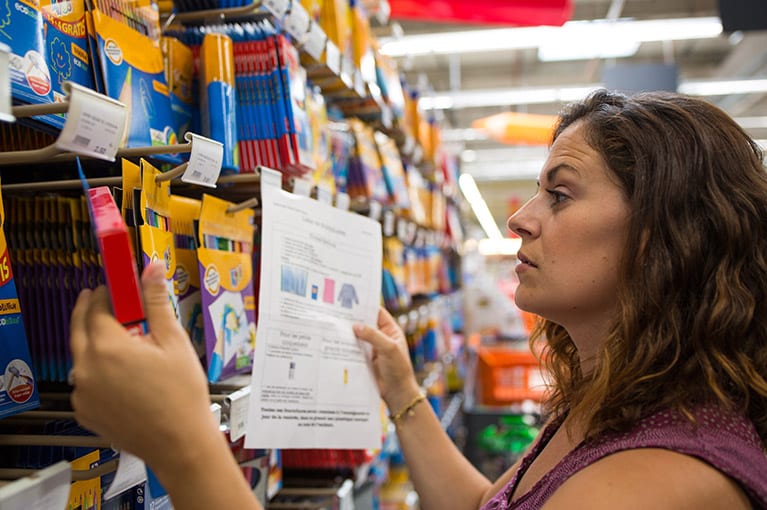
The International Council of Shopping Centers’ (ICSC) annual “Back-to-School Spending” survey revealed good news for brick and mortar retailers earlier this month. Consumers are in search of the best back-to-school deals and promotions and are hitting their local shopping centers to find them.

This year, 89% of consumers will make their back-to-school purchases in local shopping centers and malls. A vast majority (69%) will shop at discount stores, followed by office supply stores (37%) and department stores (32%). Physical interaction with goods is the top reason for back-to-school shoppers to visit stores. Most important among these shoppers are:

  • The “ability to see, touch, or try on the merchandise” (46%)
  • The “ability to browse/ease of buying specific items” (36%)
  • The “convenience of one-stop shopping” (35%)
  • “Avoiding shipping fees” (34%)

Parents of children in K-12 are expected to spend an average of $309.60 while those shopping for college plan to spend an average of $437.80. Many will wait to start their shopping until they see advertisements or sale prices in stores and nearly 90% said they’re influenced by promotions in terms of the amount they spend and the items they purchase.

“Back-to-school is one of the shopping seasons where we really find people looking for specific items at the best price,” said Tom McGee, president and CEO of ICSC. “Consumers are more informed than ever and research prices and products prior to making a purchase so it isn’t surprising that so many shoppers are waiting for sales and discounts before buying their back-to-school items.”

Digital will play a role as well, this shopping season. A majority of consumers (81%) will utilize their mobile devices while in-store shopping for merchandise. Among this group, 58% will compare prices, 39% will download digital coupons, 38% will check availability/inventory, and 30% will take pictures of items that might be purchased.

Source: Chain Store Age

Vice President Pence Speaks at Retail Advocates Summit

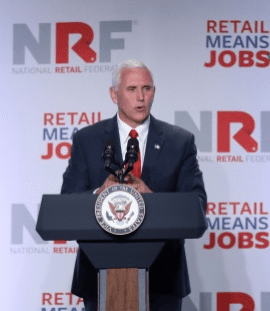
Retail Advocates SummitThe NRF (National Retail Federation) hosted this year’s Retail Advocates Summit, which was visited by Vice President Mike Pence on Tuesday. He promised that the best days for American retailers are ahead. More than 200 retail representatives from across the US attended the annual conference, held in Washington, D.C.. The main focus for the conference this year was tax reforms for retailers and their employees.

“As retail goes, so goes America,” Pence said. “This president is going to work with this Congress, this year, and pass the largest tax cuts since the days of Ronald Reagan.” The current tax code creates “huge barriers” to creating more retail jobs, he added. Many retail executives had indicated the importance of obtaining a major reduction in the corporate tax rate, which is now at 35%. Pence suggested to the retailers a cut to 15%. He also mentioned that the estate, or death, tax will also be repealed. Retailers care about this due to some being held by families. There was a heavy round of applause to this news.

“Less regulation, lower taxes, better infrastructure,” he said. The president wants retailers to be able to compete on a “level playing field” with companies all across the world, he said. [We] “will put retailers back on the path to jobs and growth and back to competitiveness.”

Vice President Pence also acknowledged “You’re one of the great job producers in America”. The NRF had cited that retail supports one in four jobs in America.

Source: CNBC, NRF