
Author: Chad Symens

What is Collaborative Planning, Forecasting and Replenishment (CPFR)?

The CPFR Method

CPFR is a business methodology which integrates multiple parties in the planning and fulfillment of customer demand.

The idea behind CPFR is that by coordinating activities throughout the supply chain inventories can be moved more efficiently, in the correct quantities, to the correct inventory locations to meet customer demand.  CPFR establishes a common language, common processes and metrics to assist the trading partners to achieve these goals.
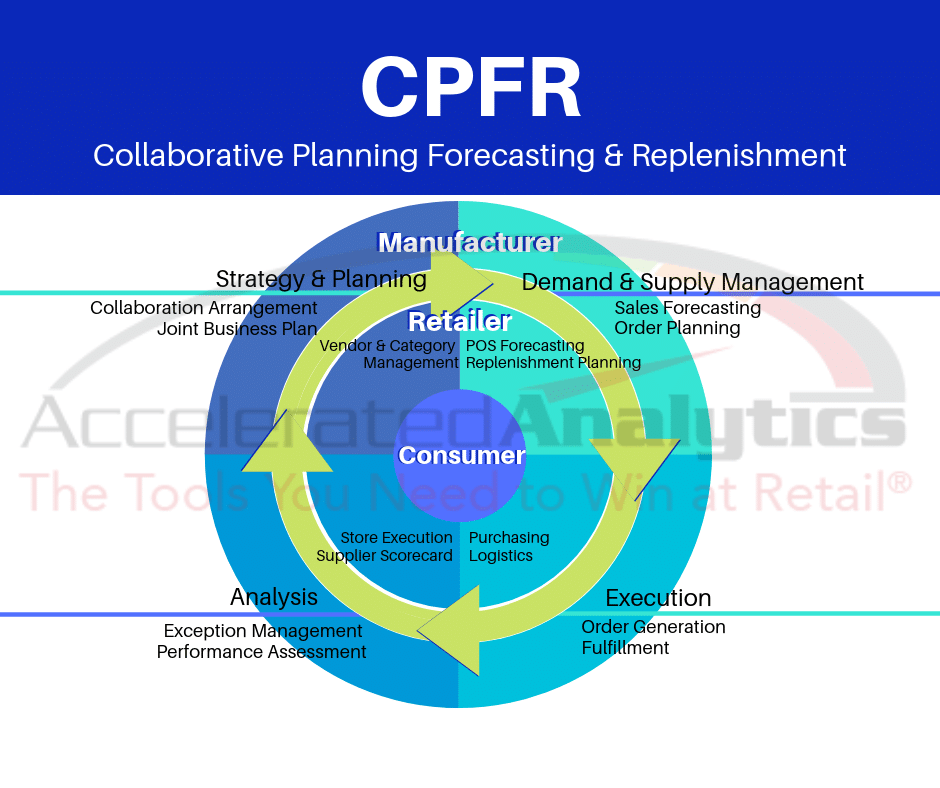
CPFR

The CPFR Model

The customer, as the creator of sales demand for a product, is at the center of the CPFR model.

Surrounding the customer is the retailer and the supporting activities provided by the retailer: Category management, POS forecasting, Replenishment Management, Buying, Logistics & Distribution, Store Execution, Supplier Scorecard, and Vendor Management.

The outside ring of the CPFR model is comprised of the manufacturer and their activities.  The model is broadly organized into four quadrants comprised of Strategy & Planning, Demand & Supply Management, Execution, and Analysis.

The retailer, manufacturer, and supply chain partners interact through a series of eight business activities: Collaboration Arrangement, Joint Business Plan, Sales Forecasting, Oder Planning & Forecasting, Order Generation, Order Fulfillment, Exception Management, and Performance Assessments.

Information Sharing in CPFR

Information sharing is a critical requirement to make a CPFR initiative successful.

Consumer demand must be quantified at a UPC/store level and quickly communicated from the retailer to the manufacturer.  The orders for new inventory must be placed quickly in the correct quantity and the orders must be fulfilled and shipped on time to ensure delivery to the shelf when the consumer is ready to make the purchase.  Any breakdowns in the communication process, or a lack of visibility into consumer demand in the cycle, has the potential to create an out of stock and lost sales will result.

Successful Inventory Allocation in CPFR Requires Constant Monitoring and Adjustment

CPFR is not a one-time event, it is a business process which follows the entire life cycle of a product and which must be continuously monitored and adjusted.

All parties including the retailer, manufacturer and supply chain participants must be involved in the planning and communication cycle.  Participants should coordinate and agreed on the initial order quantity to establish the on shelf inventory position.

Furthermore, all parties should carefully monitor demand and adjust the regular on shelf replenishment rules based on local demand which govern the flow of inventory.  Proactive pre-planning for promotions, markdowns or price changes which may impact the regular consumer demand for a product are essential to avoid out of stocks.

Is the EDI 852 document Sufficient to Enable CPFR?

The EDI 852 document (also referred to as the Product Activity Transaction Set) is the most common method for retailers to communicate retail point of sale data and inventory to manufacturers.   The most common elements of an EDI 852 document include units sold, dollars sold, and inventory on hand by UPC and store.

While the EDI 852 document provides a wealth of useful information to inform the participants of a CPFR initiative unfortunately the implementation of the EDI 852 is often incomplete.  The EDI 852 document outlines standard elements and technical details of the file structure but the implementation by each retailer varies.

One retailer may provide inventory on hand and units on order, while another may provide only on hand, or in some cases no on hand at all.  The problem is not the EDI 852 document or the standard, the problem is the implementation is not consistent.  Another problem with the EDI 852 document is the frequency of transmission.

In nearly all cases, the EDI 852 document is transmitted weekly and summarizes sales for the period.  This creates a significant delay in the manufacturer’s ability to sense and react to changes in consumer demand.   If an out of stock is encountered early in the reporting period the manufacturer will not be alerted to that for several business days.

Another very significant gap in the implementation of the EDI 852 document is units on order data.  Unfortunately, a majority of retailers do not provide this data in their EDI 852 document.  While a manufacturer may identify a spike in sales demand, they do not have order information to know if the problem has already been identified by the retailer and an action taken.

The manufacturer can separately consult their purchase order data from the retailer but with today’s modern supply chain most retailers place large orders which are destined for a distribution center which obscures the store level order information.  The retailer may have placed an order but are those units going to the store which most needs them?  This is a critical gap in the information flow which is required for a successful CPFR implementation.

Replenishment System Barriers to CPFR

Most retailers have invested heavily into information systems to forecast demand, monitor sales, and place automatic orders based on min/max inventory rules.  These systems can be very sophisticated and accurate at an aggregated level, but they are not typically monitoring individual store and product inventory positions.

A replenishment manager at the retailer is responsible for monitoring and adjusting the replenishment system to ensure inventory levels are maintained.  However, an open to buy budget has a large impact on the decisions the information system or the replenishment manager can implement.

Far too often inventory has built up in one area while other stores are starved for inventory but the overall financial position of the retailer is constrained and additional purchase orders cannot be issued.  Manufacturers may identify inventory out of stock situations and communicate the problem to the replenishment manager but the replenishment manager may be powerless to do anything to react.

For a CPFR initiative to be successful the retailer and manufacturer must defined the communication process and action steps before the inventory shortages begin to occur.  The action plan must identify who has the authority to override the replenishment system and place an order even if that means temporarily exceeding the total desired inventory position.

The allocation and redistribution of inventory must also be discussed prior to starting the CPFR initiative.  While it may be counter intuitive to create inventory positions which are significantly different by retail store location the inventory must follow, and react to, consumer demand.

CPFR – the Bottom Line

There are many case studies which point to the benefits of CPFR.  Some of these case studies demonstrate inventory reductions of 10% to 40% with corresponding improvements in sales between 5% and 20%.

It is hard to dispute that when all the parties involved in the supply chain plan, coordinate, and act that business benefits will not be realized.  The difficulty it seems comes down to efficient and consistent communication, and pre-planned agreements on what actions will be taken based on consumer behavior.

Our experience has demonstrated even when all participants are aware of a problem it does not necessarily translate into productive actions to solve the problem within a meaningful timeframe to make a significant impact.  If an out of stock occurs on a Tuesday and the manufacturer identifies it the following Monday when the EDI 852 is transmitted, and the retailer places an order on Tuesday, the shelf has been empty for a week.

That is the challenge of CPFR – communicating and acting rapidly.  This does not diminish the value of CPFR by any means; however the real world implementation is anything but easy.

Getting Started with CPFR

There are some practical steps manufacturers can take to begin on the path to CPFR:

  1. Work with your retailer to identify the gaps in the retail point of sale activity data they are providing and how they can be filled.  These gaps usually revolve around inventory on hand and on order, and the frequency of the data transmission.
  2. Work with your retailer to understand the steps involved to prevent, or at least fix, an out of stock.   Who has the authority to place an order?  Who has the authority to override the replenishment system?  Who has the authority to reallocate inventory from poorly producing locations to high producing locations?  What is the turn time from order to on shelf by region?  What are the min/max rules and how were they established?
  3. Create a system for proactive monitoring of sales and weeks of supply inventory by store and UPC.   When will the analysis be conducted each day or week?  Who owns this analysis and what actions they will take based on severity of the shortage?  If the retailer will not accept and act on the order advice is there an escalation process and who’s involved?
  4. Automate the analysis in step #3 above.   Analyzing sales and inventory at a UPC/store location presents a significant data challenge due to the sheer volume of data for most manufactures.  For example, if you have 45 UPC’s selling at 2500 retail stores there will be 112,500 rows of data to review, analyze and report.   Most manufacturers start with a spreadsheet as their tool for this process but quickly find it is a time consuming and difficult task.  As a result the analysis is not completed quickly and accurately and opportunities can be lost.   A more sophisticated solution is required which is exception based.  Predefined exception reports which alert the analyst to only those items/stores which are below desired levels can be developed.   This saves time and allows the analyst to work on the problem rather than on a spreadsheet.


Fright Night: Halloween Will be particularly scary for retailers this year but chocolate sales stay high

Halloween retail sales, which had grown to an $8 billion industry by 2012, is expected to fall 7 percent this year, to $6.9 billion. According to the National Retail Federation, this is the lowest total since 2011.

Experts blame the weak Halloween forecast on a shift in consumer spending to experiences rather than must-have items. Some retail experts view Halloween as a prediction of holiday sales, so poor results could cast a spell on the Christmas selling season. Supply and demand are not syncing, creating high inventory levels and low sell thru percentages of Halloween products.

The average American will spend $74.34 on the holiday, forecasts the NRF. This is slightly down from $77 in 2014. Although Halloween product sales may be down, malls are trying to take advantage of the holiday, as it falls on a Saturday this year, with trick-or-treat events and more Halloween-themed items on the shelves and on display. Melinda Merrill, a Fred Meyer spokesman, said that when Halloween falls on a weekday, year-over-year sales growth is typically in the single digits. “When it falls on a weekend, there are more parties, they are bigger and customers decorate and dress up for them on a bigger scale. … We’ll see much larger growth,” Merrill added.

Halloween chocolate sales generated $217 million in 2014, and remains the top-selling treat for the holiday. Leaders Hershey and Mars account for 87% of chocolate Halloween candy. Most variety bags contain chocolate over fruity or sour flavors.

Sources: New York Post, USA Today Democrat Herald, MarketRearch.com

JCPenney, WalMArt and Dollar Tree Make Job Cuts to Corporate/Non-Store Positions

Walmart recently announced cuts of 450 positions at its headquarters. Dollar Tree announced the elimination of 370 positions (115 of those unfilled currently) at its headquarters. JC Penney followed suit, announcing plans to cut 300 of its 3,400 home office positions. All are stating cuts are to reduce expenses.

JC Penney still plans to hire 30,000 seasonal workers at the store level. In a statement the company said JC Penney is working to achieve its financial growth targets, and it is essential that operations align with the strategic priorities of the company. Over the last several months, the company has been evaluating its home office structure to identify opportunities for greater simplification and higher productivity.

Walmart’s announcement indicated the job cuts are coming at a time when Walmart is investing billions into its e-commerce to better compete with Amazon. “Our customers are changing, retail is changing and we must change. We need to become a more agile company that can easily adapt to shifting customer demand,” CEO Doug McMillon told about 18,600 employees at its headquarters.

Sources: Chain Store Age and Fortune

amazon plans to hire more than 100,000 this season, expecting high e-commerce sales

Amazon.com Inc. announced plans to increase hiring by 25% over last year’s holiday season, to 100,000 workers. Workers will be in Amazon’s 50 warehouses and 20 package sorting centers around the US. This is higher than United Parcel Service (UPS) plans to hire this holiday season. Amazon is responding to US Census Bureau reports that US e-commerce sales grew 14.1% in the second quarter, while brick and mortar retail increased 1% year over year.

Most retailers’ hiring is expected to remain flat. Target, Macy’s and Walmart announced they are holding their hiring steady. Walmart is looking to hire 60,000 workers this year and Target plans for 70,000 seasonal workers. Macy’s plans to hire 85,000. All are about the same as last year.

Source: The Wall St Journal

National Retail Federation (NRF) Consumer Research Reports Consumers Plan Holiday Spending to be flat Compared to Last Year; Expect This to be biggest omnichannel holiday ever

An NRF survey of over 7,300 customers indicated that the average spending per person this year will be almost flat with last year, increasing to $806 this year versus $802 last year. This is the highest amount of spending in the survey’s 14 year history, but is still disappointing to retailers.

“We continue to see positive momentum in retail sales growth, giving us reason to believe consumers will show up this holiday season as they look to take advantage of all of retailers’ promotional offerings,” said NRF President and CEO Matthew Shay. “In an effort to attract all shoppers – from the extremely price sensitive to the online millennial, retailers will be offering exclusive incentives, low prices, price-matching, top toys and everyone’s favorite – free shipping and buy online pick up in store offers.”

It is expected to be the most omnichannel holiday ever. Online spending is expected to be 46% of total spending this year. The survey found that 21.4% of shoppers will use their smartphone to purchase holiday merchandise. 37.9% will research products on their smartphones, and 20.3% will use it to look up product availability in stores.

Adding to the complexity of predicting holiday spend is consumer spending behavior. 40% of shoppers surveyed begin their holiday shopping before Halloween. When asked why, shoppers indicated the need to spread out their budget (61%), avoiding crowds (48%) and avoiding stress of last minute shopping (46%).

Source: Retailing Today

2016 Retail Store Closings Planned

Macy’s announced it would be closing 35-40 underperforming brick and mortar retail stores in the 2016 calendar year, making room to open its discount stores. Other retailers also announced plans to close doors in 2016, including Office Depot, Walgreens, The Gap and Barnes & Noble.

While retailers are usually reluctant to announce store closures because of the uncertainty it can create with investors and analysts, it also can be viewed favorably as a company’s ability to change quickly in such a competitive retail environment.

Retailers who have announce the highest number of store closures include: Office Depot/Office Max (400 closures), Barnes & Noble (223), Children’s Place (200), Walgreens (200), Aeropostale (175), American Eagle (150), Chico’s (120) and Pier One (60).

Source: about money.com

Shipping Rates Increase as Holiday Shopping Begins

Atlanta-based United Parcel Service announced rate increases to take effect on November 2, in time for holiday shopping. UPS will increase its fuel surcharges and will double its rates to deliver oversize items. Both UPS and FedEx are increasing rates and other charges about 5%. Separately, the US Postal Service is also asking regulators to raise prices by an average of 9.5%.

New fees are also being established for retailers using third party shipments. This new fee will affect retailers that allow vendors to ship directly to consumers, or who direct goods to their own shelves for restocking.

Any price increases as likely to be passed along to consumers in higher shipping costs and/or higher prices at checkout.

Source: Wall St. Journal

US Spending Decreases to Lowest Point in 2015 in September

The US Spending Monitor decreased 3.8 points in September, reaching its lowest point in 2015 and the lowest point since August 2014. Retail spending index decreased to 3 points under the 12-month average. The decrease comes with increased negative views on the economy, spending and personal finances. Over 60% of respondents rated their personal finances as fair or poor while 35.8% stated finances were getting worse. 62.7% of respondents have 3 months or less of emergency savings, while

23.7% have none.

Retail spending continues its 4-month continuous decline. 38.2% of adults are spending less on household expenses, 37% spending less on household improvements and 33.3% spending less on clothing, footwear and accessories. The household improvements category has the highest percentage planning to spend in this category, but with only 18.9% expecting to spend more in the next month.

A majority of retail purchases are expected to be made at a retail store next month. It is expected that purchases made using mobile devices or personal computers will increase as the holiday season approaches and pre-Cyber Monday deals start.


Source: Chain Store Guide

Accelerated Analytics Congratulates Customer Vera Bradley on Sharing its Best Quarterly Results in Nearly 5 Years in Q2 2015

Vera Bradley enjoyed its best quarterly results in nearly five years, beating analysts’ expectations in Q2 2015.  Analysts predicted an 11-cent share profit, which Vera Bradley exceeded with a 15-cent share profit, and saw its sales increase 1.5 percent to $120.7 million.

The company expects profits this year to land between 72 and 78 cents per share, well beyond expectations of 66 cents.

The retailer’s strategy is focused on luring more shoppers into its brick-and-mortar mall storefronts and increasing consumer attention on its brand.

Vera Bradley has been a customer of Accelerated Analytics since 2013, utilizing our POS and 852 sales and inventory reporting to drive sales and optimize inventory levels at many of its department store retailers.

The Home Depot Builds Third Facility of 1.6 Million Sq Ft to Support Omni-channel Operations; Will Open a New Technology Center in Marietta, GA in October

The Home Depot is officially opening a third facility to support its online business. The new 1.6 million facility in Ohio will employ 500 employees and will support its online operations that currently account for 5% of its business and continues to grow.

Home Depot also announced plans in October to open its Marietta Technology Center, a 200,000 square foot office complex that will employ 1,000 IT jobs. The Home Depot has enhanced its IT capabilities in conjunction with its supply chain and merchandising operations.

“These investments are advancing our interconnected retail strategy, which allows our customers to engage with Home Depot however they choose,” said Craig Menear, chairman, CEO and president of The Home Depot. “We’re also pleased to contribute to the economic growth of these communities.”

The Home Depot is not the only major retailer ramping up fulfillment support for omnichannel retail. WalMart is spending $200 million to build a new distribution center in Polk County, Florida dedicated to fulfilling e-commerce orders.

Source: Retailing Today