Author: Chad Symens

WARM WEATHER HELPS HOME DEPOT SALES RISE ALMOST 10% IN 4TH QUARTER, AS HOME PRICES INCREASE AND DEMAND FOR NEW HOME CONSTRUCTION STARTS 2016 WITH SLOW GROWTH

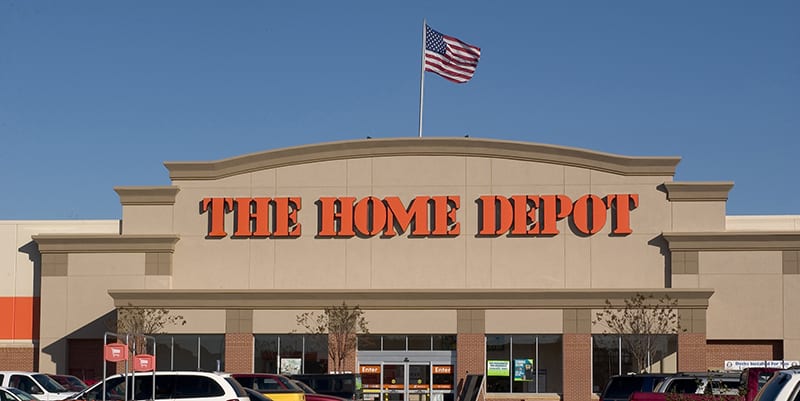
The Home Depot’s fourth-quarter sales included an 8.9% sales increase in US stores that have been open for at least one year. This is despite the challenges facing the rest of the retail industry. Sales were strong the entire quarter, but warm weather in December brought in a sales spike – Home Depot attributes $100 million in sales growth to the milder weather. High sales were seen for power washers and pressure-treated lumber by homeowners building decks.
Home prices also rose in December, showing the strongest gains since July 2014. The Home Price Index showed a rise of 5.2% in the 12 months ending in December, versus a 5.2% in November. The national median sale price for a home in December was $213,800, 8.2% from the previous year. There is a limited inventory of homes for sale, and demand for new homes is likely to drive more new construction and help keep a ceiling on the rising home prices, although January 2016 was a slow start for new home construction for the year.

Accelerated Analytics helps Home Depot vendors, such as WM Barr, Hillman Group, Alexandria Molding, and CPG Building Products to manage their sales and inventory data to drive results. Our vendors use our analytical measures, such as sell through, inventory shortages, out of stocks, weeks of supply and consumer purchasing trends, to take quick actions to ensure they are optimizing inventory and growing sales.

Source: Wall St. Journal
AMAZON ANNOUNCING INCREASED SHIPPING FEES AND A PRIVATE LABEL APPAREL LINE MAY BE ON THE WAY

Big changes are being announced at Amazon.com. Based on shipping price increases imposed by UPS and FedEx late last year, Amazon announced its threshold for free shipping is increasing by 40%, to $49 in orders. However, Amazon is not raising the threshold with an interest in shipping revenue, but instead to incent more customers to become members of Amazon Prime.

Amazon Prime members always receive free shipping on all orders, but membership costs $99 per year. These customer spend on average double what Amazon’s other customers spend, and absorbing shipping costs will be nothing to them compared to the billions of dollars in sales the company may gain.

Amazon is also hiring heavily to staff up its Amazon Fashion Private Label unit, which could take on fast-fashion chains to sellers of basic apparel. An analyst at Women’s Wear Daily estimates Amazon could launch a private label apparel brand by early 2017. Amazon can undercut prices that other fashion retailers have at brick and mortar stores, and its ability to collect customer data can help them to give customers exactly what they want.

Many Accelerated Analytics’ vendors utilize our POS reporting and analysis tools to manage their Amazon sales and inventory. These vendors sell online with the retail giant in addition to selling at department store brick and mortar stores and online sites. Being able to compare sales trends between them is a key tool to help them win at retail and ensure customers are able to access the products they want to buy regardless of which retailer they are shopping with.

Sources: Wall St. Journal, New York Business Journal

NRF SAYS MILLENNIALS WILL SAVE THEIR TAX REFUNDS INSTEAD OF SPLURGING ON RETAIL

Retailers have depended on American’s using their IRS tax refund checks to boost February and March sales. However, according to a survey conducted by the National Retail Federation (NRF), more than half of those expecting a refund are planning to save their money instead of spend it. This is the highest level since the NRF has begun conducting the survey.

Millennials, ages 18 to 24, show 57.3% planning to save and 27.4% planning to spend their refunds on everyday purchases like gas or groceries. In the 25 to 34 year old bracket, 52.3% plan to save and 45% plan to repay debt.

In addition to saving, 22.4% of Americans will save their refunds while 11.4% will plan a vacation. “Consumers are building their spending power and boosting their confidence as they set aside their checks from Uncle Sam,” NRF president and CEO Matthew Shay said. “Americans this year see refund season as a time to improve their financial health by using their refunds to get ahead on savings goals and plan for bigger purchases in the future. Money saved is money waiting to be spent.”

As refund checks start to get into Amercan’s hands, it will remain to be seen if this holds true for future retail spending and whether they will actually save the money or decide to shop instead.

Source: Chain Store Age


Leading Solution for DIY POS Retail Reporting

At Accelerated Analytics, we work extensively with The Home Depot, Lowe’s, and Wal-Mart data and we know how to integrate your item catalog, shipping data, plan o gram, and other key files for a comprehensive reporting solution.  With our services, you’ll have more timely reporting in a consistent format available to any user with an internet connection, iPad, or iPhone.  Your analysts will be able to focus on the business instead of making spreadsheets. Plus you will have store / SKU level reporting.  Talk about powerful!

NEW HOME CONSTRUCTION DROPS AGAIN WITH SLOW START IN 2016 – WILL HOME DEPOT EARNINGS BE AFFECTED?


Showing the lowest rate since October, new housing starts fell 3.8% in January from a month earlier. U.S. home builders are reporting a positive outlook as spring approaches, citing solid fundamentals for housing demand, such as job gains and low mortgage rates. Demand for housing has been strong over the past year but growth has been slow, with housing starts just 1.8% higher than January 2015.

Home builders are reporting shortages of land and labor, leading to project delays and higher construction prices, which lowers demand for new homes. However, new home sales in December were up 9.9% from a year earlier. “The weak showing in construction activity is broadly consistent with the recent souring in home builders’ sentiment, and when combined with the downdrift in permit approvals it suggests some slowdown in the months ahead,” said Millan Mulraine, economist at TD Securities USA, in a note to clients.

The Home Depot performed very well in 2015, giving investors better returns than competitor Lowe’s. The Home Depot opened 2016 with a large pullback due to fears about the general economy and the housing market in particular. An anticipated rise in mortgage rates has not happened and Home Depot is gearing up for spring, its busiest period of the year. The company will hire more than 80,000 workers for its 2,000 stores and 75 distribution facilities. The Home Depot’s domestic business has kept it in the lead, but with Lowe’s announcement of its acquisition of Canadian home-improvement chain Rona, international expansion could be important to future growth.

Source: WSJ

NORDSTOM IS RANKED FAVORITE RETAILER IN RECENT SURVEY

A survey of over 5,700 consumers found that Nordstrom ranked first among retailers in customer satisfaction. It specifically ranked highest scores for atmosphere, checkout speed and finding the correct size/product the customer was looking for. One in five customers surveyed indicated they were dissatisfied in general with their fashion retail experience across all retailers. 40% of these customers indicated that the sales experience was very important to them, and that less than half of them were approached by a sales associate, which was key to their satisfaction. Nordstrom’s sales associates assisted customers the most and received the highest satisfaction scores.

Coming in behind Nordstrom were Marshalls, H&M, Ross, Kohl’s and Macy’s.

With merchandise selection and ease of finding items and size selection the top of customers’ needs, retailers and vendors recognize the importance of partnering to share point of sale and inventory data in order to optimize store assortments. Many vendors, such as Brahmin Leather, Anastasia Beaute and The Sak, utilize Accelerated Analytics to monitor and act on inventory levels and customer buying patterns in Nordstrom and other retailers to maximize their effectiveness in this area.

Source: Chain Store Age

Economic Mixed Messages

By Chad Symens

This article recently caught my attention and the wheels started turning: https://www.cnbc.com/2016/02/11/is-the-us-economy-running-out-of-gas.html.

The current economic situation is confusing to the casual observer.  On the one hand, President Obama regularly speaks about the US economy being the strongest and most resilient economy in the world, and yet articles like this create doubt in the minds of the average observer.  Gas prices are at historic lows, and the unemployment rate is back down to pre-recession levels.  Yet polls consistently show that Americans are unhappy with the the direction of the economy and the leading presidential candidates are outsiders running campaigns against the “establishment”.  Q4 earning and full year earnings are also confusing. Home improvement stores are doing very well, but department stores and large mass merchants are struggling.  Today the Federal Reserve sent conflicting messages about the economy being strong, and the possibility of a recession is still out there.

What are we supposed to make of all this?

I’m no economist but my observation is the average American consumers are pulling back on discretionary spending and focusing on paying down debt and putting some extra money into their savings.  Home improvement retail sales clearly show consumers are investing into their homes and taking the savings at the gas pump and putting it into their homes or their savings accounts. Depending on your point of view this can be both positive and negative considering US consumers have historically had higher levels of debt than other countries. But the debt level of the US consumer is rapidly decreasing. Does the generally conservative approach to finances mean consumers, who drive the economy, are pulling back and won’t help to sustain the economic recovery?

Business at Accelerated Analytics has been expanding exponentially in the last 90 days. We are seeing companies across multiple retail channels invest into analytics and reporting because they understand that to win at retail they have to be smarter and faster than their competition.  Those businesses are investing into productivity and technology, not pulling back.  These businesses are small, medium, and large. They represent a good cross section of the economic landscape and watching them invest makes me optimistic.  I believe the economy is going through a routine cycle of smart and successful companies growing and investing and conservative companies that only risk and fear pulling back.  To me it seems to be a very Darwinian cycle where the smartest and strongest will thrive and the weak will struggle and possibly fail.

I’m bullish on the economy’s prospects.  What do you think?

NRF THINKS 2016 WILL BE A HAPPY NEW YEAR FOR RETAIL

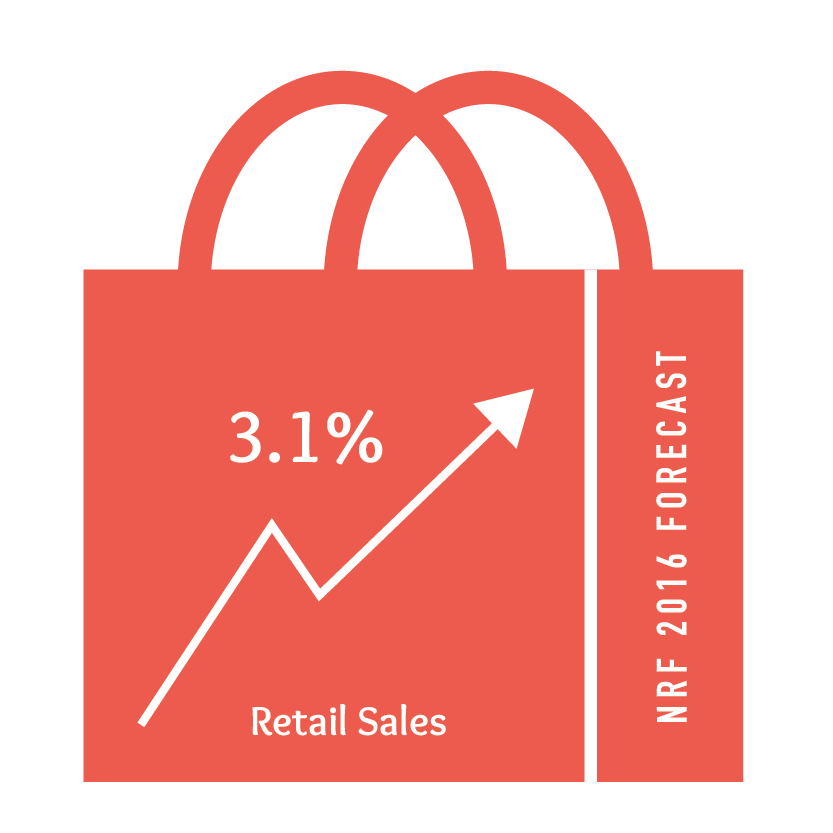
The NRF forecasts a 3.1% increase in retail sales growth in 2016, which will exceed the 10 year industry average of 2.7%. The National Retail Federation also forecasts ecommerce growth to be between 6-9%.

The NRF makes this forecast based on assumptions on employment gains. It believes that prospects for consumer spending are going to be higher as it expects a continued growth in the labor market.

“Wage stagnation is easing, jobs are being created and consumer confidence remains steady, so despite the headwinds our economy faces from international developments, particularly in China, we think 2016 will be favorable for growth in the retail industry,” said NRF President and CEO Matthew Shay.

The NRF’s chief economist indicated that with lower gas prices creating more discretionary income, more jobs, and with retailers continuing to find ways to compete and succeed in a cost-conscious environment, 2016 should be a good growth year for retail.


Source: Chain Store Age

Game Changer for the Home Improvement Market?

by Chad Symens

Lowe’s acquisition of Rona could be game changer for the home improvement market. Home Depot has 2,273 stores with 182 located in Canada. Before the Rona acquisition, Lowes had 1,840 stores including Orchard Supply stores. The Rona acquisition will add 496 stores to Lowe’s portfolio which means that once it’s finalized, Lowe’s will have 2,336 stores compared to Home Depot’s 2,273.

Nearly half (238) of the Rona stores are in Quebec which represents nearly 25% of the entire Canadian home improvement market; a market where Lowe’s does not currently operate any stores. The Canadian home improvement market is estimated at over C$45 billion and is forecasted to grow at a CAGR of 3.9% from 2014 to 2018.  Lowe’s will be very well positioned to capture an oversized share of the growth compared to Home Depot with their 182 Canadian stores. In 2015, Home Depot acquired Interline Brands as a strategy to expand the pro division sales.  It will be interesting to see which strategy – investing in the pro business versus acquiring more physical store space – will turn out to be the better strategy.