
Author: Chad Symens

Upscale Cosmetics Sales are Beautiful

The upscale beauty business continues to shine. In 2015, prestige beauty – makeup, fragrances and skin care products that are not found typically at drug stores, saw a 7% increase in sales. Sephora and Ulta each posted phenomenal sales results. Estee Lauder raised its sales forecast as demand for their product line are growing. The makeup subcategory was the strongest, with a 13% increase last year.Upscale Cosmetics

In a “selfie-ready age” and YouTube and Pinterest an easy way to get product tutorials, makeup trends are growing the sales. Thicker eyebrows are trendy, so products such as brow-enhancing serum and eyebrow mousse are becoming more popular. In our health-conscious society, products with natural or clinical orientation, which are pricier, comprise the largest share of prestige skincare sales.

JC Penney plans to accelerate its Sephora Inside JC Penney locations, and Kohl’s has redesigned its beauty area on 900 of its stores. Macy’s acquired $210 million Bluemercury, and plans to grow to 150 locations in the next 2 years. Target acquired Sonia Kashuk brand, and L’Oreal is opening brick-and-mortar locations of its NYX Cosmetics concept.

Accelerated Analytics works with a large percentage of beauty brands, such as L’Oreal, Anastasia Beverly Hills, Estee Lauder, Parlux Fragrances and LVMH. Click here to see our full list of beauty vendors, who utilize Accelerated Analytics’ POS reporting tools to track sales and inventory levels at their retailers, such as Dillard’s, Macy’s, Sephora and Ulta.

Source: Washington Post

Retailers Unprepared for Future Labor Challenges According to Survey

JDA Software Group recently conducted a new survey of more than 250 store managers and found that retailers are unprepared for the “perfect labor storm” that’s brewing. It’s fueled by new and shifting labor regulations and ever-expanding customer needs.
The Voice of the Store Associate Survey found that over half of respondents feel only somewhat prepared to staff appropriately to meet customer demands. They rely primarily on outdated forms of scheduling, like pen and paper, whiteboard or an Excel spreadsheet, and have yet to develop and deploy a modern workforce management (WFM) solution into their planning process.

Retail store managers face staffing challenges due to the increased demands that come with services such as Buy Online Return In Store and Buy Online Pick Up In Store. And, the lack of automated systems to predict staffing needs is resulting in increased labor costs. In addition, state and federal agencies are proposing and passing new labor laws that will have a direct effect of how retailers manage and pay employees.

“The research raises serious questions as to how much attention retailers give to managing their staff efficiently, predicting customer demand needs and complying with new or pending labor regulations,” said Tyler Owen, senior director, global solutions strategy, store operations, JDA Software.


Source: Chain Store Age

H&M’s Expansion Plan Includes 425 New Stores

Swedish retailer H&M recently revealed its aggressive plans for both physical and digital growth in 2016. The company will open its 4000th location when they add 425 stores this year. H&M also plans to expand its e-commerce efforts to Japan and 10 other markets.

“Our strong expansion continues, we are gaining market share and we are confident that we can grow at a fast pace both through stores and online, in existing as well as in new markets, for many years to come,” said H&M CEO Karl-Johan Persson. “The spring will bring many store openings, for example the opening of flagship stores in South Africa, Switzerland, Hungary and India. Since 2010 we have doubled the number of stores in the group, and this April we will pass another milestone when store number 4,000 opens.”

H&M has chosen Mall of India in New Delhi as the location of it’s 4000th store.

The addition of 11 new e-commerce markets will give H&M omnichannel capabilities in 34 markets by the end of the year. Their new markets include Japan, Ireland, Croatia, Slovenia, Estonia, Latvia, Lithuania, Luxembourg, Greece, Canada and South Korea.

Source: Chain Store Age

First Revenue Decline a Wake-Up Call for Retail Giant Walmart

According to its annual financial filing released on Wednesday, for the first time since the company went public 45 years ago, Walmart’s revenues declined from the year before.

With over 11,500 store in 28 countries worldwide, the retail giant brings in half a trillion dollars in sales each year. Is it possible that they’ve hit their growth limit? In February, Walmart lowered its annual net sales growth forecast to “relatively flat” from earlier guidance that called for an increase of as much as 4 percent.  Part of the 2015 sales drop is attributed to currency impacts and a decrease in fuel sales due to lower gas prices. Sales have also suffered from ongoing store closures, including its entire fleet of smaller, “Express” stores.

But, Walmart has acknowledged a shift in the way it runs the company. They’ve moved away from their previous focus on net sales and cutting operating expenses as a percentage of sales, and are now focused on making “strategic investments” to support the “long-term health of the company.”

What has been a mostly brick-and-mortar operation is morphing into one that meets the expectations and demands of consumers operating in an omni-channel marketplace. This can already be seen in its fast-growing app and its expanding grocery pick-up program.

While its first revenue decline should serve as a wake-up call, Walmart remains a massive retail force.

Supplier Survey Reveals Positive Outlook for Retail Sales

In a new survey conducted by Capital Business Credit, 75% of major retailers of soft goods such as clothing and accessories expect retail sales to grow by 4% or more for the spring and summer shopping season. If they do, they will outpace core GDP growth and provide a jolt to the economy.

According to the Global Retail Manufacturers and Importers Survey, a majority of those surveyed believe that 2016 will either be better (45.5%) or the same (38.6%) as 2015.

“While retail sales for January and February were lower than initially anticipated, this hasn’t seemed to deter retail suppliers’ confidence or business activity,” said Andrew Tananbaum, executive chairman, CBC. “In fact, nearly 90% of importers and suppliers are reporting reorders for the spring/summer shopping season.”

The reorders mean that the major retail chains and individual stores are optimistic. Retailers have become increasingly reticent to stock shelves if they don’t think products will sell according to Tananbaum.

The survey results found that over 3/4 of retailers have increased their orders or stayed the same; approximately half indicated that they have increased their orders. And of those who increased their orders, 1/3 ordered 7% to 10% more, while almost 30% said that orders increased by more than 10%.

Impact of the Chinese Yuan

With so many U.S. retail goods produced in China, the devaluation of the yuan has been an important factor for importers and retailers to increase profitability while keeping prices low. Half of survey respondents are considering increasing their Chinese production due to the strong dollar vs. the yuan.

Just over a third (37%) believe that margins may increase due to the lower cost to produce goods in China, but the majority (56.7%) do not think this will translate into lower consumer prices.

“While the overall recovery from the great recession of 2008 has been sluggish, the low costs of goods produced in China has allowed the U.S. consumer to stretch their spending dollars and allowed retailers to keep costs down,” Tananbaum concluded. “In our opinion, this is the first time since the recession that manufacturers, importers and other participants in the retail goods supply chain will have the opportunity to recover some of the margins they lost over the past decade.

Source: Retailing Today

FIRST QUARTER 2016 CONSUMER ECONOMIC NEWS: SPENDING IS SOFT BUT HOME SALES RISE

As the first quarter of the year comes to a close, consumer spending stayed soft, rising just 0.1% for the third consecutive month. Incomes have been rising faster than that rate, indicating that Americans seem to be saving rather than spending. Gross Domestic Product (GDP) growth also slowed. Consumer spending generates more than 2/3 of total US economic output. Economists are concerned but a recession is not being indicated yet since the markets stabilized and the job market appears to be on track.

On the home sales front, there is more optimistic news. Pending home sales jumped 3.5% in February, the highest level in 7 months. Pending sales offer insights into future sales activity. The Realtors’ is forecasting 5.4 million existing-home sales this year, an increase of 2.4% from 2015. The housing market in 2015 was the strongest since before the recession and 2016 seems stronger yet.

Source: Wall St. Journal

Dollar General Growth Continues with 1,900 New Stores by 2017

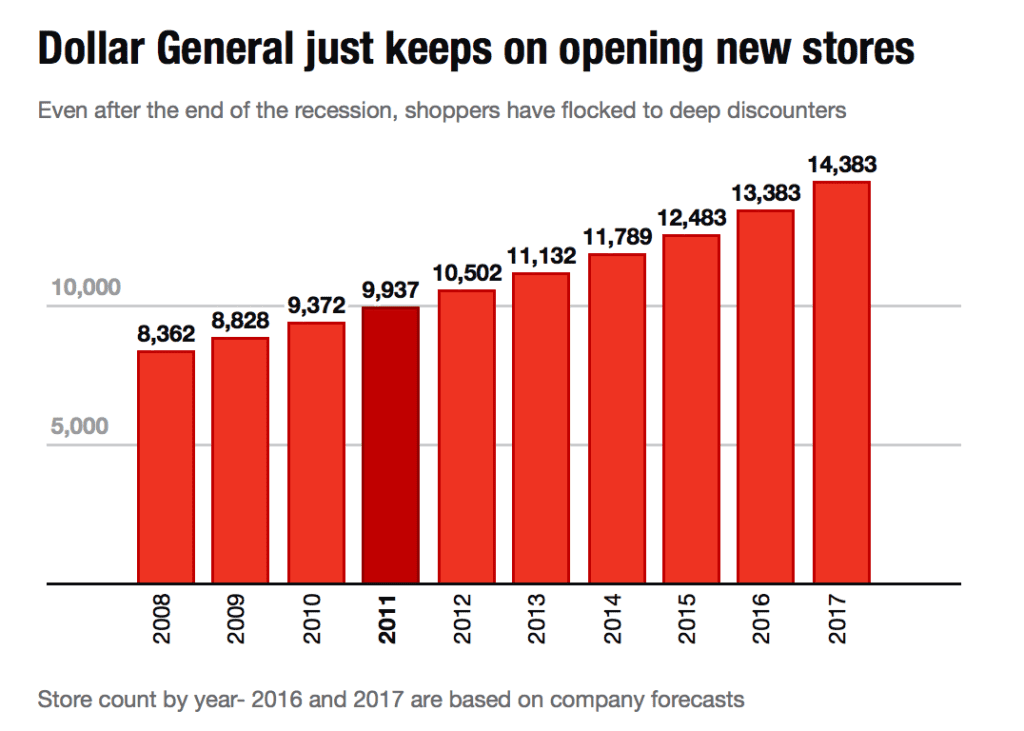
In an era when e-commerce is growing and chains like Kohl’s, Macy’s and Staples are closing stores, Dollar General is expanding. At it’s annual investor day last Thursday, the discount chain announced it will open 900 new stores this year and plans to open another 1,000 in 2017. Adding 1,900 new stores will bring Dollar General’s store count to over 14,000.

Last year was Dollar General’s 26th straight year of same-store sales growth and they have added new stores consistently for the past 8 years, growing from 8,362 locations is 2008 to nearly 12,500 by the end of 2015.

In the late 2000’s, as the economy rebounded from the recession, deep discount retailers like Dollar General, Dollar Tree and Family Dollar exploded in popularity as consumers sought discounted items at no-frills stores located close to home so they could save on gas. Consumer’s frugal spending habits have continued and Dollar General is targeting annual sales growth of 7% to 10%.

Source: Fortune.com

Warm Weather Expected to Boost Consumer Spending and Apparel Sales

Despite an expected snow storm in the mid-Atlantic States and New England, consumer spending and apparel sales should both rise as the weather improves, according to analytics firm Planalytics. In its weekly report, Planalytics said that warmer weather is resulting in “many consumers thinking and purchasing spring. The warming conditions during the Easter run-up period will help drive demand for seasonal apparel as well as live goods.” Looking ahead, the analytics firm said, “western locations can expect strong gains for both spring apparel and consumables.
Last week, the warmer weather already had an impact on retail sales – but not in all regions. Chief economist of the Retail Economist LLC,  Michael Niemira said spring-like “weather continued to drive interest in spring clothing in the east over the past week, but cool and wet weather in the west curtained demand.” Easter sales are getting a slight boost due to the holiday falling early in the season this year.

Looking ahead, Planalytics said that businesses throughout North America can expect above normal temperatures in most markets over Easter weekend. “Sandals, short sleeve shirts, cold beverages and sun care will be in demand as temperatures rise above normal,” researchers said.

Source: planalytics.com

Macy’s CEO Thinks Amazon Threat is Overstated

Last year, Wall Street firm Cowen & Co. famously predicted that Macy’s would be be dethroned by Amazon.com as the top apparel retailer in the U.S. But Macy’s CEO Terry Lundgren believes that Macy’s nearly 800 stores offer a huge advantage over Amazon. He noted that shoppers typically order multiple sizes of the same piece of clothing, keep the one that fits, and send the rest back.

According to a Cowen research report published in July, Amazon’s apparel business was on pace to hit $16.34 billion for the year, compared to $22.2 billion for Macy’s in 2015. But as Amazon pushes further into fashion beyond basic clothing, it could get dinged by all that merchandise being sent back.

“They’re going to have an interesting challenge when they start getting all those returns coming back online,” said Lundgren. He added, “The large, large majority of online purchases which are returned in our case come back to stores because they’re so convenient. And so we at least have a shot at selling them something else.”

Despite closing 36 stores this year, Macy’s is now the fourth largest U.S. internet retailer according to eMarketer, with annual online sales in 2015 of about $5 billion. Their position as a leader in the online market is a result of years of multi-billion dollar investments in integrating its stores and its digital business. The ability to handle returns of online orders is key to generating traffic to stores.

Source: Fortune.com

NRF SAYS CONSUMERS PLANNING TO SPRING INTO RETAIL SPENDING ON ST. PATTY’S DAY AND EASTER

With two big spring holidays upon us in March, the National Retail Federation reports that consumer spending appears to be on the rise. The NRF conducted two consumer surveys that indicate that trend is coming. According to its annual St. Patrick’s Day Spending Survey, over 125 million Americans will spend $4.4 billion on today’s holiday. 56.5% of those celebrating will purchase food and beverages, 28% will buy apparel or accessories, 23.3% will buy decorations and 17.2% will buy candy.

According to the NRF Easter Spending Survey, consumers plan to shop at 13-year high levels. The holiday is expected to reach spending of $17.3 billion. Half of that spending will be on clothing, gifts and flowers. “Retailers are beginning one of their busiest times of year and are more than ready as consumers shop for Spring essentials, “NRF President and CEO Matthew Shay said.

58.4% of shoppers will head to discount stores, followed by 41.4% in department stores. Online shoppers grows to 21.4%, up from 18.8% last year.

Source: National Retail Federation