Author: Chad Symens

Weather Trends: April 2014

March 28, 2014

Weather Trends International expects April 2014 to trend the coldest in five years and drier than last year for the U.S. as a whole.  Warmer year-on-year temperature trends in the Central states will be sandwiched in between colder trends on the East and West coasts.  A more active severe weather season than last year in the South Central states can be expected, especially across parts of Texas and Oklahoma.  Storm cleanup supplies and plastic sheeting will see increased demand in harder hit areas.  There is the potential for a hard frost and freeze through late in the month in the Northeast, Great Lakes and Ohio Valley, which could damage tender vegetation in garden centers.  Following another cold March, the start of the season for many spring categories will fall into the retail April month in the East, except for the Deep South where spring has already sprung.  Although the weeks before Easter on the East Coast will trend colder than last year, most of the colder trends will fall on the weekdays while the weekends look more favorable helping to drive holiday apparel and footwear demand.  Drier trends in Florida and the Midwest will be beneficial for store traffic and outdoor categories, but wetter weather in the Southwest and South Central states will inhibit traffic at times.


Source: Retailing Today, Weather Trends International

Fred’s Fourth Quarter Takes Hit

March 27, 2014

Favorable tax credits and a 53rd week in fiscal 2012 affected Fred’s net income results for the fourth quarter.  Severe weather also contributed some to the company’s net sales decline, as did higher-than-normal utility bills and rising generic drug costs.

The company reported a substantial 34.5% decrease in its net income during the quarter of fiscal 2013, to $5.56 million from $8.49 million in the same quarter a year earlier.  Net sales declined 7.2% to $495 million from $533.4 million, and same store sales grew 0.1%.

“Our comapny’s performance in the fourth quarter reflected all the difficulties that have been cited throughout the retail sector recently as we dealt with the unusually harsh weather of the past several months and a significant 24% increase in the cost of generic drugs, which reduced gross margin by 100 basis points in our pharmacy department,” said CEO Bruce A. Efird.  “Operationally, we achieved earnings of $0.17 per share for the quarter.”

During the full fiscal year, Fred’s net income fell 12% to $26 million from $29.6 million and net sales dropped 0.8% to $1.94 million from $1.95 million.

Looking ahead, total sales for first quarter 2014 are expected to be flat to up 2%.  Same-store sales for the first quarter are expected to be flat to down 2% reflecting poor weather conditions and weather-related store closings that have affected Lawn & Garden and other seasonal merchandise.

Source: Retailing Today

The Wealth Effect And Consumer Spending

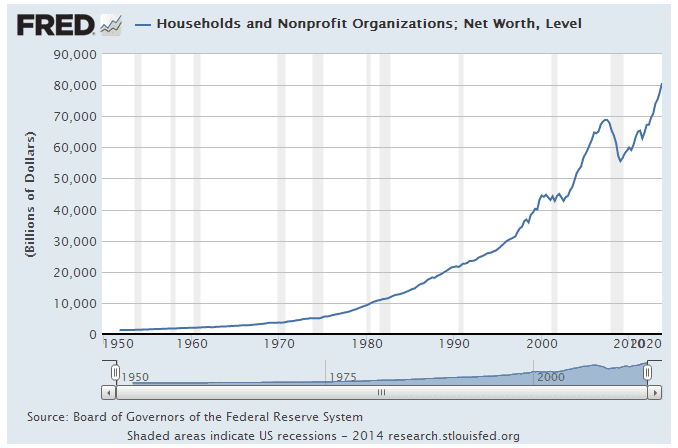
A recent Federal Reserve report shows that household finances have regained substantial ground since the Great Recession, driven largely by the run-up in home values and surge in stocks.  These positive forces have contributed to the highest level of wealth in our history – the net worth of U.S. households and nonprofits reached $80.7 trillion by the end of 2013.

The effect of wealth on consumption is an issue of longstanding interest to economists, which has sparked interesting research and debate.  As wealth accumulates, consumers increase confidence, and with it, consumer spending and the use of credit.  Based on this reasoning, economists are anticipating further growth and gains this year. 

However, not all wealth is created equal, and its impact on consumption and spending varies.  Housing prices have a larger role in consumer spending compared with financial wealth like stocks and bonds.  Here’s how.

Housing Prices

As home prices rise, households regain equity (they owe less on their mortgage than the value of their home).  As a result, they may find it easier to sell, refinance or borrow.  Overall, equity as a share of real estate has reached 51.7%, the highest point since the recession.

The key to increased spending, though, is how individuals turn rising home values into cash.  How much depends on how easily individuals can borrow and the desire by banks to lend.  For every dollar increase in housing values, research has estimated that consumption increases between 6 and 9 cents.

Stocks and Bonds

Stocks and bonds amount to 35 percent of net worth, and are at the highest level in 15 years.  Compared with housing wealth, financial wealth is readily accessible and much easier to convert into cash.  With this ease, you might think its impact on spending would be larger than housing.  However, research has found just the opposite.  For every dollar change in financial wealth, consumer spending tends to only increase by 2 to 4 cents.

The reduced impact of financial wealth is largely due to the fact that it is not shared as broadly as housing wealth.  There are many more Americans with homes than financial investments.  However, some analysts believe that the wealth and consumption relationship may not stem from the direct effect of financial wealth on spending, but rather from a signaling channel.  That is, as stock prices rise and fall, household optimism about the economy may cause households to revise their expectations about their future wages and consumption.

Optimistic Expectations

In the coming months, higher home and equity values (the wealth effect) combined with the use of consumer credit, should add to the pace of consumer spending.  While take-home pay remains the primary source of consumer spending, access to credit also plays a large role into economic activity.

Even though consumers have taken advantage of extremely low interest rates to purchase big ticket items, that doesn’t mean households are returning to pre-Great Recession spending habits.  It appears that there is more responsible borrowing on the part of consumers.  Credit card use has been extremely tepid as consumers remain hesitant to return to 2007-2008 behavior.  If consumers remain hesitant, their improved finances may not lead to big gains in spending.

I remain optimistic about consumer spending this year thanks to better employment prospects, a strengthening balance sheet and an expected uptick in after-tax income that makes it easier to finance debt dependent purchases.

This optimism is tempered with the reality that rising interest rates could otherwise thwart consumer attitudes toward spending and borrowing.  If interest rates begin to rise, it would make it more expensive for households to access and utilize credit and limit the increase in home prices.  Alternatively, if interest rates remain steady as we expect, consumers should gain more confidence as the employment situation improves, spurring additional spending and economic activity throughout 2014.

Source: National Retail Federation

Walgreens Sees Top-Line Growth In Second Quarter

March 25, 2014

Despite expected headwinds from slower generic drug introductions, comparisons with last year’s flu season and severe weather, Walgreens saw solid top-line growth in the second quarter ended February 28, driven by record quarterly sales and record second quarter prescriptions filled.

The company also continued to gain prescription market share while maintaining a firm hold on its costs. 

Walgreens posted a sales increase of 5.1% to $19.6 billion for the quarter.  First half sales were up 5.5% to $37.9 billion.

Prescription sales, which accounted for 62.2% of sales in the quarter, increased 7%, while prescription sales in comparable stores increased 5.8%.  The company filled 214 million prescriptions in the quarter, an increase of 2.8% over last year’s second quarter.  Prescriptions filled in comparable stores increased 2.2% in the quarter.  As of February 28, Walgreens increased its retail prescription market share 20 basis points from a year ago to 19% as reported by IMS Health on a 30-day adjusted basis.

Walgreens also saw strong growth in prescriptions filled for Medicare Part D patients, which increased 16% in the second quarter compared with last year’s quarter, while the company’s Part D market share increased 80 basis points in February compared with the same month a year ago.  “Our Medicare Part D program is accelerating our momentum in pharmacy,” Greg Wasson, president and CEO Walgreens, told analysts.  “As we move forward we are well positioned with senior customers as a preferred provider in four of the top national plans,” he said.

And Walgreens has been recognized by patients and payers for tightly integrating its health and wellness services with its retail clinic offerings, Wasson said.  Patients appreciate the convenience of services and payers view Walgreens as an emerging alternative healthcare model and part of the patient care delivery team, he said.  “To help meet this growing demand, we have a goal to add nearly 100 new Healthcare Clinic locations in calendar 2014 on top of our 400 current retail clinics.”

In addition, Walgreens has grown its 90-day at retail business substantially.  The 90-day at retail prescriptions were up 15%, Wasson said.  “For perspective, our 90-day at retail alone is as large as one-third of the total mail market industry,” Wasson said.

The total number of all CDC-recommended immunizations and vaccines administered by Walgreens reached 8.6 million in the first half of the fiscal year, an 11% increase over the previous year.

Front-end comparable store sales increased 2% in the second quarter, customer traffic in comparable stores decreased 1.4% and basket size increased 3.4%, while total sales in comparable stores increased 4.3%.

“We head into the second half of the year with nearly 80 million active members in our Balance Rewards loyalty program and with expectations that the generic drug headwind that affected the first half will ease and turn around by the end of the year,” Wasson added.  “With 80 million active members – we now have the largest loyalty program in the industry,” he told analysts.

The company is leveraging insights from its Balance Rewards loyalty program to provide customers with more value and simplified promotions.  Balance Rewards reached a milestone in February with more than 100 million enrollees and nearly 80 million active members at the end of this year’s second quarter.

Walgreens is also leveraging its omnichannel reach across all sales channels, Wasson said.  “Today, 9 million customers touch the Walgreens brand every day – at our stores, over the web or through mobile channels – making Walgreens a true omnichannel provider.”

“In addition, our joint synergy program with Alliance Boots is expected to exceed its second-year estimate, and we are bringing critical elements of the Well Experience to additional stores,” Wasson noted.  Wasson noted there are now 628 Well Experience stores across the nation.

The combined synergies for Walgreens and its strategic partner, Alliance Boots, in the first half of fiscal 2014 were approximately $236 million.  The joint synergy program is now estimated to deliver second-year combined synergies of $375-$425 million, an increase from the previous second-year estimate of $350-$400 million.

Walgreens also announced Tuesday that as part of its efforts to optimize the company’s asset base, it plans to close 76 drug stores during the second half of fiscal 2014.  Including these store closures, Walgreens still expects a net increase in its store count in fiscal 2014 of approximately 55-75 locations.  “While we seize the opportunity for store growth as the population ages and consumers look to community pharmacy for their health care needs, we also continue to focus on optimizing our assets and organization to position Walgreens for our future as a global company,” Wasson said.

The store closures represent less than 1% of Walgreens’ store base, Wasson added.

In the fiscal 2014 second quarter, the company opened or acquired 28 new drug stores compared with 29 in the year-ago quarter.

At February 28, Walgreens operated 8,681 locations in all 50 states, the District of Columbia, Puerto Rico, Guam and the U.S. Virgin Islands.  The company has 8,210 drug stores nationwide, 138 more than a year ago.  Walgreens also operates worksite health and wellness centers, infusion and respiratory services, specialty pharmacies and mail service facilities.  Its Take Care Health Systems subsidiary manages more than 700 in-store convenient care clinics and worksite health and wellness centers.

Source: Retailing Today 

New Home Sales Continue To Trend Relatively Flat In February

March 25, 2014

Sales of newly built, single family homes fell 3.3 percent to a seasonally adjusted annual rate of 440,000 units in February, according to newly released figures from the U.S. Department of Housing and Urban Development and the U.S. Census Bureau.

“There is no doubt that the persistently bad weather took a toll on sales in February,” said Kevin Kelly, chairman of the National Association of Home Builders and a home bulder from Wilmington, Delaware.  “However, builders continued to increase their inventory of for-sale homes, indicating they still anticipate a relatively strong spring buying season.”

“We still expect 2014 will be a strong year for housing,” said NAHB Chief Economist David Crowe.  “The first two-month average of 2014 is exactly in line with where 2013 left off.  If not for the unusual weather, we would easily be ahead of last year’s pace.  We also continue to see household formations and pent-up demand sales forward.”

Regionally, new home sales activity fell 32.4 percent in the weather-battered Northeast, 1.5 percent in the South and 15.9 percent in the West.  The Midwest posted a gain of 36.7 percent, stemming from an unusually low January figure.

The inventory of new homes rose to 189,000 units in February, a 5.2 month supply at the current sales price.

Source: National Association of Home Builders

The Conference Board Consumer Confidence Index Rebounds In March

March 25, 2014

The Conference Board Consumer Confidence Index, which had decreased in February, improved in March.  The Index now stands at 82.3, up from 78.3 in February.  The Present Situation Index edged down to 80.4 from 81.0, while the Expectations Index increased to 83.5 from 76.5.

“Consumer confidence improved in March, as expectations for the short-term outlook bounced back from February’s decline,” said Lynn Franco, Director of Economic indicators at The Conference Board.  “While consumers were moderately more upbeat about future job prospects and the overall economy, they were less optimistic about income growth.  The Present Situation index, which had been on an upward trend for the past four months, was relatively unchanged in March.  Overall, consumers expect the economy to continue improving and believe it may even pick up a little steam in the months ahead.”

Consumers’ assessment of current conditions was little changed in March.  Those claiming business conditions are “good” increased to 22.9 percent from 21.2 percent; however, those claiming business conditions are “bad” also rose, to 23.2 percent from 22.0 percent.  Consumers’ appraisal of the labor market was relatively unchanged.  Those claiming jobs are “plentiful” decreased marginally to 13.1 percent from 13.4 percent, while those saying jobs are “hard to get” increased slightly to 33.0 percent from 32.4 percent.

Consumers’ expectations, which fell last month, rebounded in March.  The percentage of consumers expecting business conditions to improve over the next six months increased to 18.1 percent from 17.3 percent, while those anticipating business conditions to worsen declined to 10.2 percent from 13.6 percent.  Consumers’ outlook for the labor market was also moderately more optimistic.  Those expecting more jobs in the months ahead edged up to 13.9 percent from 13.7 percent, while those expecting fewer jobs fell to 18.0 percent from 20.9 percent.  The proportion of consumers expecting their incomes to grow declined to 14.9 from 15.8 percent, but those anticipating a decline in their incomes also decreased to 12.1 percent from 13.4 percent.

Source: The Conference Board

Walmart Testing Convenience Concept

March 18, 2014

Walmart this week opened its first small format convenience store branded as Walmart To Go in its hometown of Bentonville.

The concept offers a familiar blend of convenience store products, prepared foods and gasoline and is not to be confused with Walmart’s other small format concept known as Walmart Express.  The Express format measures about 15,000 sq. ft. and also appeals to convenience minded shoppers with gas, a pharmacy and fresh food offerings.  The Walmart To Go store bears the same name as a home delivery grocery service the company launched three years ago in San Francisco and expanded to Denver last year.

The Walmart To Go store is located at the heavily trafficked intersection of South Walton Boulevard and S.W. 14th Street, less than a half mile south of Walmart’s headquarters.  The intersection is well suited to a convenience store format with easy ingress and egress.  However, as retail tests go, Walmart won’t get a true read on the viability of the concept until it is exposed to competition in a market where the shopper base is not distorted by those who work for or sell products to Walmart.  The proximity to the retailer’s headquarter ensures that a large percentage of those visiting the store will have some type of Walmart affiliation.  Also of note is the fact that the most meaningful competition for Walmart To Go will come from other Walmart formats.  A Walmart supercenter with a gas station is located adjacent to Walmart’s headquarters and a 45,000 sq. ft. Neighborhood Market store, which is also designed to satisfy shoppers’ convenience needs, opened last year and is less than a mile from the new Walmart To Go.

Source: Retailing Today

Kenmore And Craftsman Can’t Help Sears

March 14, 2014

Sears Hometown and Outlet Stores said Fourth-quarter same-store sales declined 3.4% as two of the company’s best known brands had disappointing results. 

Sales in the fourth quarter declined 4.5% to $602.4 million due to the combination of a 3.4% same-store sales decline and an extra week in the fourth quarter the prior year, which added sales of $36.5 million.  The same-store sales decline was made up of a 4% decline at the Hometown division and a 1.5% decline at the Outlet division.

The comp decline was primarily driven by lower consumer electronics sales following a planned exit from the category in most Hometown stores, lower sales in the tool category in both segments, lower apparel sales in Outlet stores and lower major appliance sales in Hometown.  The decreases were partially offset by higher lawn and garden sales in Hometown and higher major appliance and furniture sales in Outlet.  If consumer electronics are excluded from the comp calculations, the total decline was only 1.1% overall, consisting of a 1% decrease at Hometown stores and a 1.3% decrease at Outlet stores.

“Fourth quarter results were disappointing, especially in the Hometown and Hardware segment where holiday sales and margins of our important Kenmore appliances and Craftsman tools significantly underperformed management’s expectations,” said president and CEO Bruce Johnson.  “In the Outlet segment, increased holiday promotional spending did not drive the expected sales increases.  Total company January sales were negatively impacted by the unusually severe winter weather in many of our trade areas.” 

That said, Johnson noted that the company made significant progress on four key strategic fronts during the quarter that leave it favorably positioned for 2014.  For starters, Johnson said 30 new stores were opened during the past fiscal year with half of those coming in January.  “Total sales from these 30 new stores during the first quarter of 2014 to date have met our expectations, with particularly strong sales from the new Outlet Stores, which accounted for 13 of the 30,” Johnson said. 

The company also continued its transition to a model whereby stores are operated primarily by independent dealers and franchises.  After 19 conversions in the fourth quarter, 1,115 of the company’s 1,260 stores are now operated by dealers and franchisees.  Johnson also said the company achieved double-digit year-on-year growth in both online and multichannel sales, particularly at Searsoutlet.com, where sales for the quarter grew nearly 80% from the prior year to approximately $11 million.

Finally, new Outlet sourcing initiatives began to shift inventory positions in furniture, apparel and out-of-box appliances, to products Johnson said he is confident will deliver higher overall merchandise margins than in the fourth quarter of 2013.

Source: Retailing Today

Retailer Portals

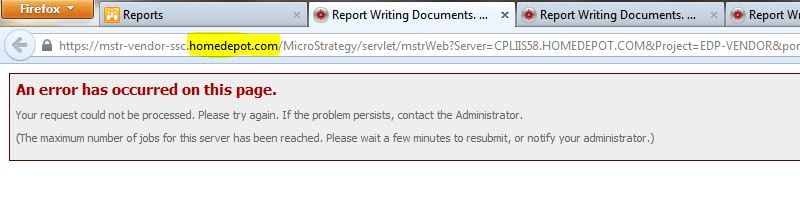
My team has the opportunity to spend a significant amount of time in various retailer portals downloading store lists, POS data and other files as part of the work we do for our customers.   We routinely encounter errors with the portals and in particular during peak times like early morning.   When prospective customers ask me why they should purchase a service like Accelerated Analytics instead of just using HomeDepotLink or RetailLink or Partners Online I often let them know one reason is because those portals tend to unavailable for significant portions of the day.   

Looks like today is going to be one of those days….


Shopping Paused This Winter, Will Pick Up This Spring

March 13, 2014

Consumer spending on retail sales rose a healthy 0.3 percent in February, despite widespread inclement weather.  This good result essentially offsets the declines registered in January.  The core retail sales measure that excludes autos, building materials and gasoline also advanced a solid 0.3 percent supporting consumer spending in Q1.  Online store sales rose a robust 1.2 percent, as shoppers turned to the internet given the inclement weather in the month.  Although there is some lingering uncertainty about the strength of the labor market going forward – delivering more jobs and perhaps higher wages.  There could be a further bounce this spring as some shoppers finally get out as warmer weather arrives.  Still, the direction of the consumer market for the remainder of the year is more dependent on the strength of the labor market.  The upscale market is and will continue to do fine.  For the mid to lower-scale retail market, better weather could mean a little better sales record but sales are likely still to be constrained on the upside by sluggish wage gains.

Source: The Conference Board